

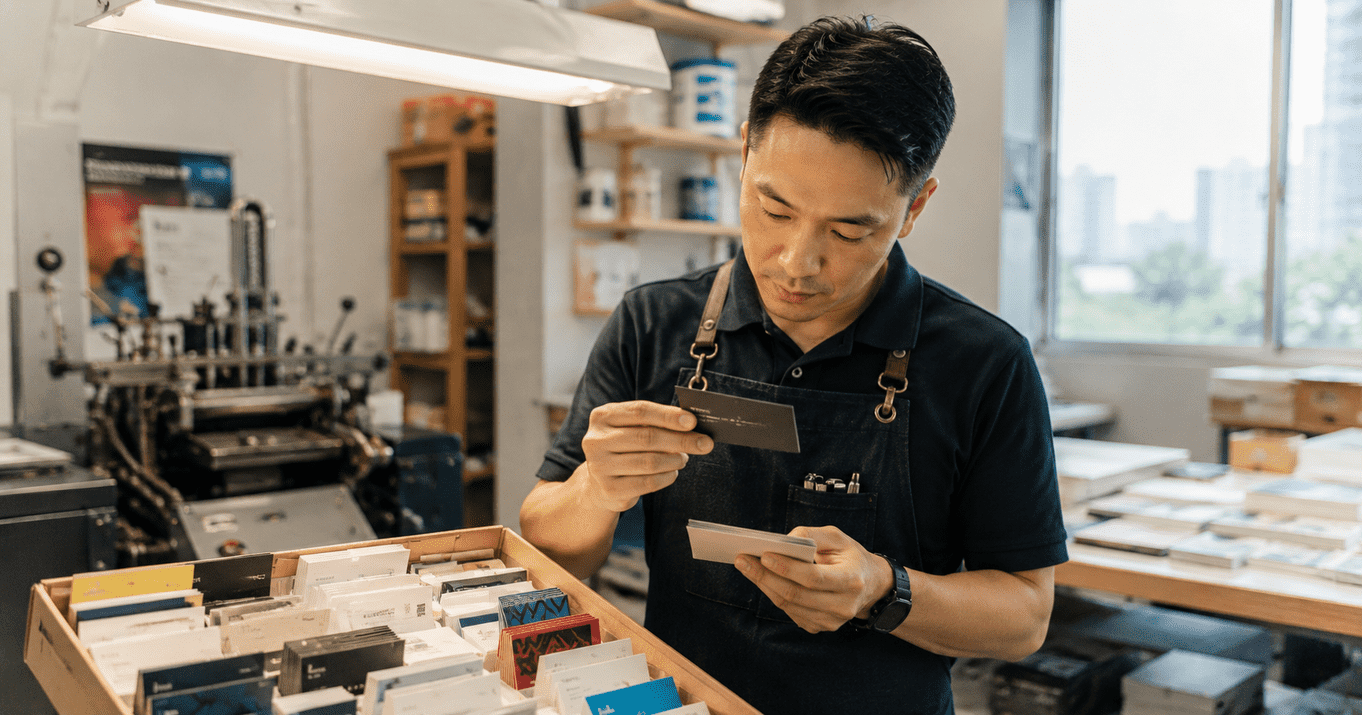
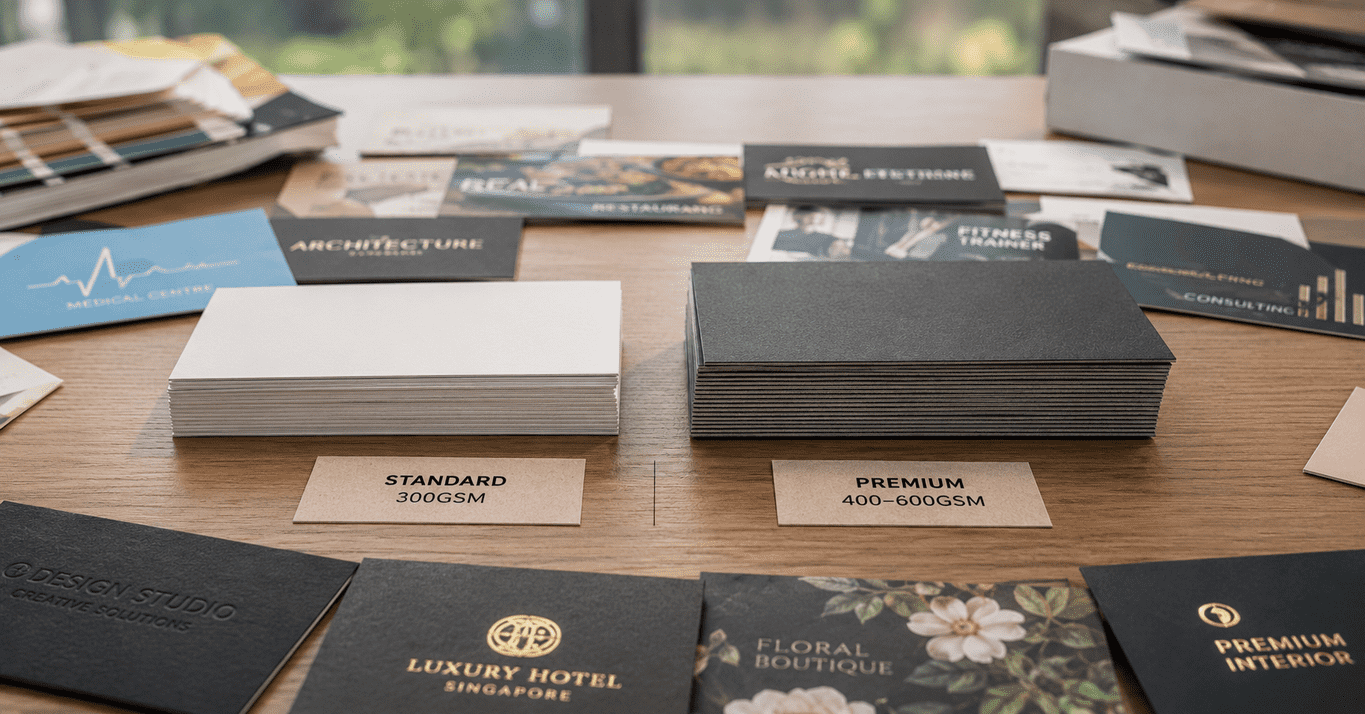
You hand someone your card and they have maybe three seconds before it either goes into their shirt pocket. In those three seconds the weight, texture and finish are either confirming or undercutting everything you just said about yourself.
Business card printing in Singapore ranges from basic and functional to high-end and impressive. Surprisingly, the price difference between the two isn’t as huge as most people think. Instead of just looking for the cheapest option, the real question is which style actually fits the situation you are printing for.
This guide covers what separates a standard card from a premium one, where the upgrade makes sense, and what to sort out in your artwork before ordering from a printing shop in Singapore.
What a standard business card actually is
Standard in Singapore means roughly 90mm by 54mm, printed on 310 to 350gsm art card in full-colour CMYK, usually with a basic gloss or matte finish or uncoated. Available the next day from most local print shops, and they do what they need to do.
For a lot of situations this is exactly right. If you’re handing out cards constantly, at trade shows, retail counters, every networking event on your calendar, spending more per card doesn’t make sense because the individual impression matters less than the volume. The card is a functional hand-off.
The problem is when people print standard cards for high-stakes moments and wonder why the card doesn’t quite land. A lawyer meeting a new client, a designer at a pitch, a founder at a conference where everyone is in the same category as you. In those contexts the card isn’t just information delivery, it’s a physical signal about the kind of business you run.
What actually makes a card premium
Stock weight
You notice a 400gsm card immediately, it doesn’t flex when you hold it, and that solidity registers as quality before any conscious thought. 600gsm is even heavier than most people expect a small card to be.
Lamination
Gloss laminate makes colours vivid and reflective, good for brands with strong visual identities. Matte laminate is flat and non-reflective, the more sophisticated option most professional services in Singapore have settled on. Soft-touch or velvet laminate goes further still, a slightly velvety texture that feels noticeably different and is hard to describe until you’ve held one.
Special effects
Spot UV, a clear high-gloss varnish on selected areas like your logo, creates striking contrast on a matte base without being garish. Foil stamping in gold, silver, rose gold or holographic catches light in a way print cannot. Embossing and debossing raise or recess the surface, adding a tactile, three-dimensional element.
| Feature | Standard Card | Premium Card |
| Card weight | 310 to 350gsm | 400 to 600gsm |
| Surface finish | Uncoated or basic gloss | Matte, soft-touch, velvet laminate |
| Special effects | None | Spot UV, foil, embossing, debossing |
| Feel in the hand | Light, slightly flexible | Solid, rigid, noticeably heavy |
| Best context | High-volume distribution | First impressions that need to land |
| Turnaround | Often same day or next day | Usually 2 to 4 days |
When the upgrade is genuinely worth it
Professional services across the board, lawyers, consultants, architects, financial advisers, where the card proxies for the quality of the work. A light, basic card creates a disconnect when you’re charging professional rates, whereas a premium card removes it.
If you’re a founder or executive, your card represents the business. You’re probably only giving out a few hundred cards a year anyway, so it makes total sense to invest in making them look right.
If you’re a designer, photographer, or brand consultant, your card is a direct reflection of your taste. It’s also your best tool at busy networking events. When someone goes through a pile of cards at the end of the day, a heavy matte finish ensures yours stands out from the rest.
When standard is the smarter choice
Trade shows and exhibitions where volume matters more than individual impression, since most cards handed out won’t convert and cost per card matters.
Functional cards like appointment reminders, referral cards or delivery slips, where the information is the point and no one needs a soft-touch laminate on it.
And when testing a new design, print standard first to confirm the layout and information are correct before committing to a premium run. Much cheaper to catch a typo on a standard run than on a spot UV or embossed 400gsm duplex card.
A note on double-sided printing
Don’t waste the back of your card as it’s a valuable space for a tagline, services list, or QR code. The only time a blank back works is when true minimalism is part of your brand identity. It needs to feel like an intentional design choice, not a budget constraint dressed up as a style.
What to sort out before you order
To keep your logo perfectly sharp, always use vector formats like AI, EPS or PDF, since raster images below 300 dpi at print size look soft on a small card where every detail is magnified. Keep all text and logos at least 3mm from the edge given the typical plus or minus 1mm trim tolerance, and extend any full-bleed background 2mm beyond the cut line on all sides.
If your brand has a specific Pantone, provide that reference alongside your CMYK breakdown so the printer has something to aim at. And on quantity, a box of 100 disappears faster than expected, ordering 250 or 500 is usually cheaper per unit and avoids a rush reprint in three weeks.
Ordering business cards at Orange Print
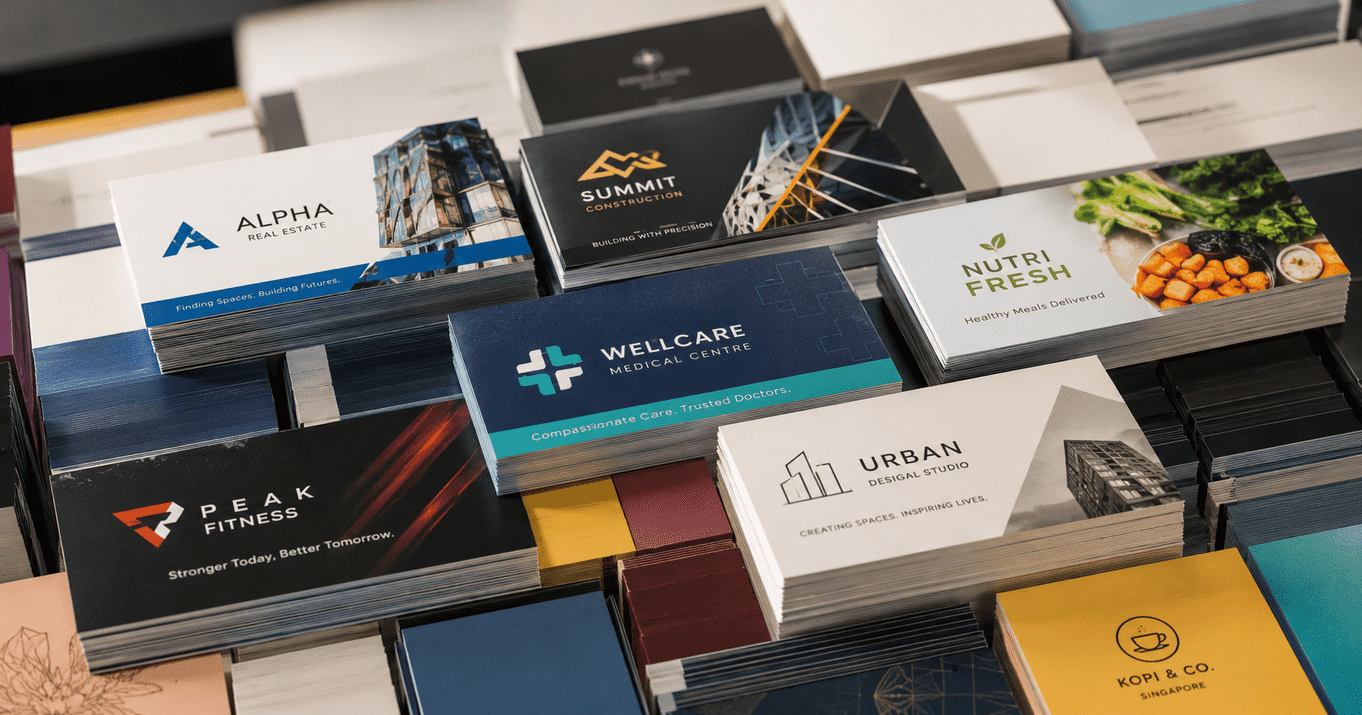
At Orange Print we print business cards digitally from our Sembawang facility across the full range of stock and finish options, from standard artcard to soft-touch laminate and spot UV. Pricing is available via the calculator on the product page.
Same-day turnaround on standard cards is available depending on production load, WhatsApp +65 8438 1313 or use the live chat on the site before placing the order to confirm capacity.
If you’re searching for a printing shop near me for business cards, it’s worth checking whether the same shop can also handle your document printing, custom paper bags, or other stationery needs in one trip. Most businesses end up ordering name cards alongside at least one other print product, and having everything come from a single printing service near you saves a second pickup.
Frequently asked questions
1. What is the standard business card size in Singapore?
90mm by 54mm is the universal standard. Some designers work at 85 by 55mm, which is the ISO standard, and either work at most print shops. Square cards at 55 by 55mm or 60 by 60mm are a popular premium variant that sits differently in a wallet.
2. What is the actual difference between matte laminate and soft-touch laminate?
Both are flat, non-reflective surfaces. Soft-touch has a micro-textured finish that feels slightly velvety under your fingertip, noticeably different from standard matte when you compare them side by side. Soft-touch is generally the more premium feel of the two and is also slightly more expensive.
3. How many cards should I order?
For someone in a client-facing role who attends events or meetings regularly, 500 is a practical quantity. For general staff, 250 is usually sufficient. For founders or senior executives, ordering 250 to 500 and reprinting when contact details change is more sensible than holding thousands in stock.
4. How long does business card printing take in Singapore?
At Orange Print, express same-day turnaround is available on standard cards when you confirm capacity before ordering. Premium finishes such as spot UV and embossing or debossing typically add 2 to 3 working days on top of standard turnaround. Get in touch.