

If you need saddle stitch booklet printing in Singapore — for a programme book, product catalogue, event guide or school magazine — you have three binding options to choose from, and saddle stitch is the fastest and most affordable of them. This guide covers what saddle stitch is, when it’s the right fit, how many pages it handles, and how to prepare your file so your first proof comes back right.
Key takeaways
- Saddle stitch binds folded sheets with two wire staples through the spine — the same binding used for most event programmes, catalogues, and A5 magazines.
- It works for 8 to around 64 pages in multiples of four. Above that, switch to perfect bind or hard cover.
- The most common Singapore sizes are A5 and A4, on 80–128 gsm paper, sometimes with a heavier cover.
- Saddle stitch is the cheapest and fastest binding we offer — typical turnaround at Orange Print is 3–5 working days for 300–100,000 copies.
- For print runs under 500 copies, consider a short-run digital booklet instead. For more than 80 pages, consider perfect binding.

What is saddle stitch booklet printing?
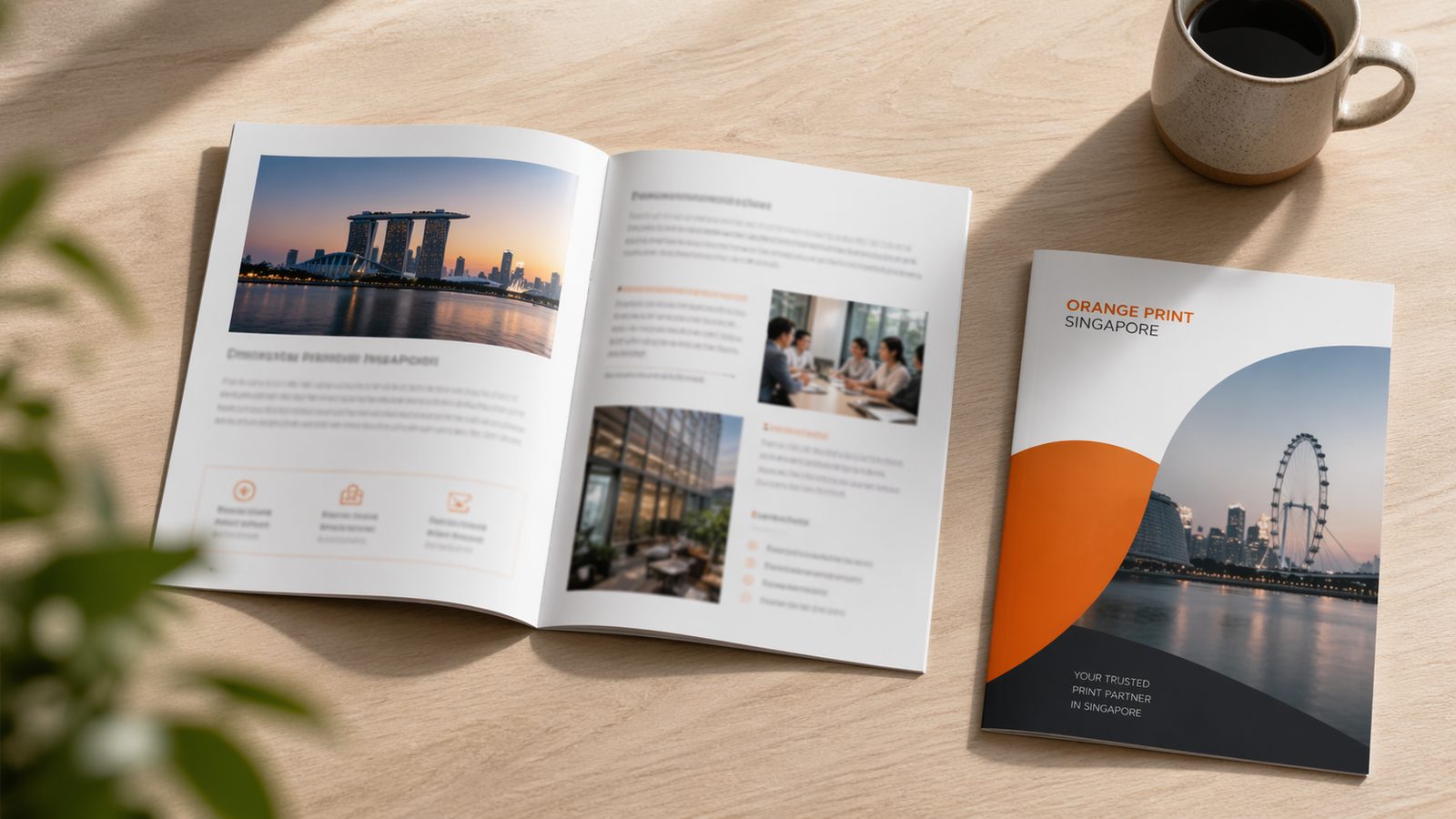
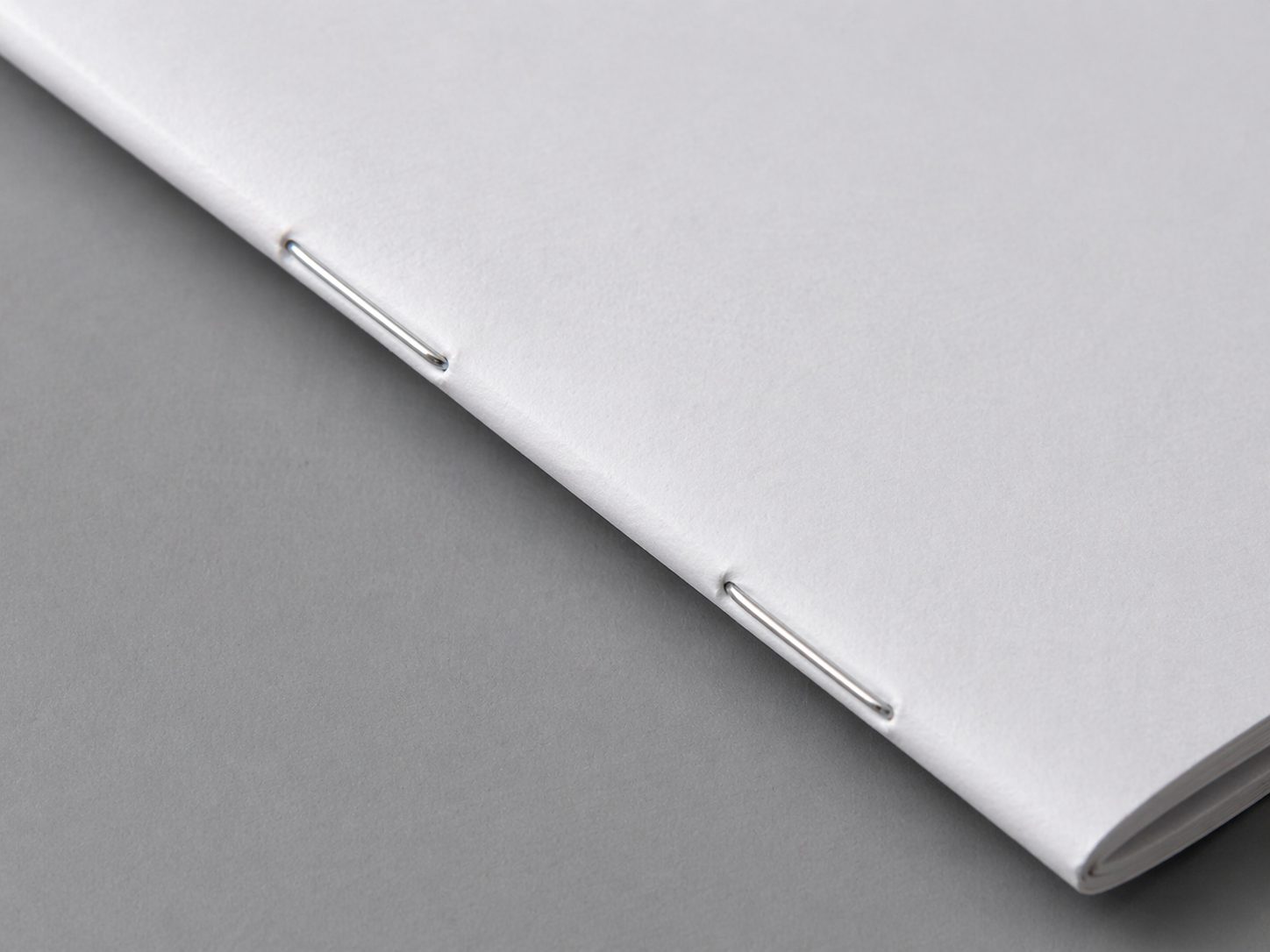
Saddle stitch booklet printing is the process of printing pages on large sheets, folding them in half, nesting them together, and binding them through the folded spine with two wire staples. The finished booklet opens flat and lies neatly. The name comes from the saddle-shaped frame the folded sheets rest on during stapling. In Singapore, saddle stitch is the standard binding for A4 and A5 booklets up to about 64 pages.
When saddle stitch is the right choice
Saddle stitch is the default binding for any short to medium booklet where you need it to look professional, open flat, and arrive quickly. Common uses we see at Orange Print include:
- Event programmes — gala dinners, school concerts, community events, product launches.
- Product catalogues — 16 to 48 pages, showcasing a small-to-mid range of SKUs.
- Annual reports and summaries for SMEs and non-profits.
- Yearbooks and commemorative booklets for schools and clubs.
- Instruction manuals and quick-start guides that ship with a product.
- Recipe booklets, magazines, newsletters, brochures over 8 pages.
If your booklet needs to survive daily handling for months on a retail shelf, or your page count is creeping past 80, saddle stitch may not be the right choice — we cover the alternatives below.
Saddle stitch specifications that matter in Singapore
Page count
Saddle stitch always uses a page count that is a multiple of four, because each printed sheet folds into four pages. Typical ranges at Orange Print:
- 8 pages — a single folded A4 sheet, already feels like a proper booklet.
- 12 to 24 pages — the sweet spot for most event programmes and short catalogues.
- 28 to 48 pages — standard for larger catalogues, magazines, yearbooks.
- 52 to 64 pages — the upper end for saddle stitch. Past this, the centre pages start to bulge and the staples begin to struggle.
If your content ends up 66 pages or more, the correct move is not to force saddle stitch — it’s to switch to perfect binding, which handles 80 to 300+ pages cleanly.
Finished size
The most common saddle stitch booklet sizes in Singapore are:
- A5 (148 × 210 mm) — the default for event programmes, catalogues, and hand-out guides. Printed two-up on SRA3 sheets.
- A4 (210 × 297 mm) — chosen when content needs more breathing room, or for technical and manual-style booklets.
- Custom square (200 × 200 mm, 150 × 150 mm) — popular for lifestyle brands and commemorative publications.
- Half A4 landscape (210 × 148 mm) — useful for restaurant menus and product one-pagers.
Paper stock
The right paper depends on how the booklet feels in the hand:
- 80 gsm woodfree — everyday office feel. Light, affordable, good for internal documents.
- 100–128 gsm art paper (matte or gloss) — the most common body paper for Singapore saddle stitch. Sharp photo reproduction, holds vivid colour, premium feel.
- 150 gsm art paper — for short catalogues and magazines where the body needs to feel more substantial.
- 210–260 gsm art card cover — heavier cover stock, often matte-laminated for a premium finish.
You do not need to match cover and body stock. A 260 gsm laminated cover wrapped around a 128 gsm body is a classic Singapore event-programme build.
Saddle stitch vs perfect bind vs short run — which one should you pick?
Three quick rules will tell you which binding to print:
- Under 500 copies? Use a short-run digital booklet. Digital printing is cheaper than setting up offset plates for a small run.
- 300 to 100,000 copies, up to 64 pages? Saddle stitch is your answer. Fastest turnaround, lowest per-unit cost, opens flat.
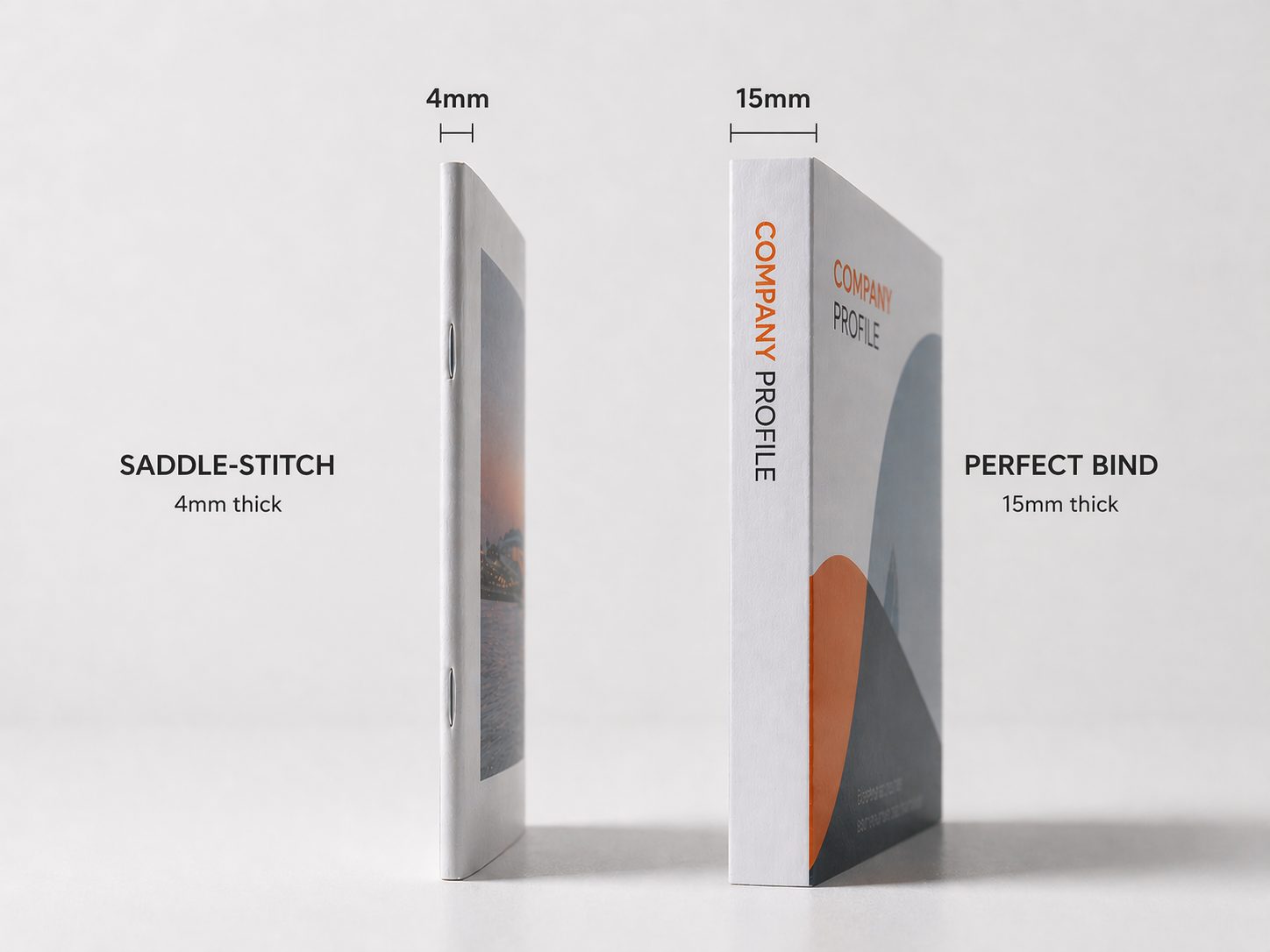
- 80 pages or more, or you need a flat spine? Choose perfect binding. It gives you a printable spine, a more book-like feel, and handles up to about 300 pages.
For archive-quality publications that need to last decades — coffee-table books, school yearbook reference copies, milestone commemorations — consider hard cover book binding. It’s our most durable format.
How much does saddle stitch booklet printing cost in Singapore?
Price depends on five things: quantity, page count, finished size, paper stock, and finishing. As a rough guide for an A5, 24-page saddle stitch booklet on 128 gsm art paper with a 250 gsm art card cover:
- At 300 copies, unit cost comes down to the low single-dollar range.
- At 1,000 copies, per-unit cost drops roughly 40–50% from the 300-copy rate.
- At 5,000 copies and above, you move into bulk offset territory and per-unit cost drops again.
For an exact quote, the Orange Print saddle stitch booklet page has an instant online calculator — choose size, pages, paper, and quantity to see a live quote before you submit any files.
How to prepare your file for saddle stitch printing
A few file rules will save you a proofing round:
- Export as a single PDF, in the reader’s reading order (page 1, page 2, page 3…). Do not pre-impose pages yourself — our RIP handles imposition.
- Total page count must be a multiple of four. If your content ends on page 22, add pages 23–24 (even if blank) to reach 24.
- Add 3 mm bleed on all four sides of every page. Important images and text should stay at least 5 mm inside the trim line to survive trimming.
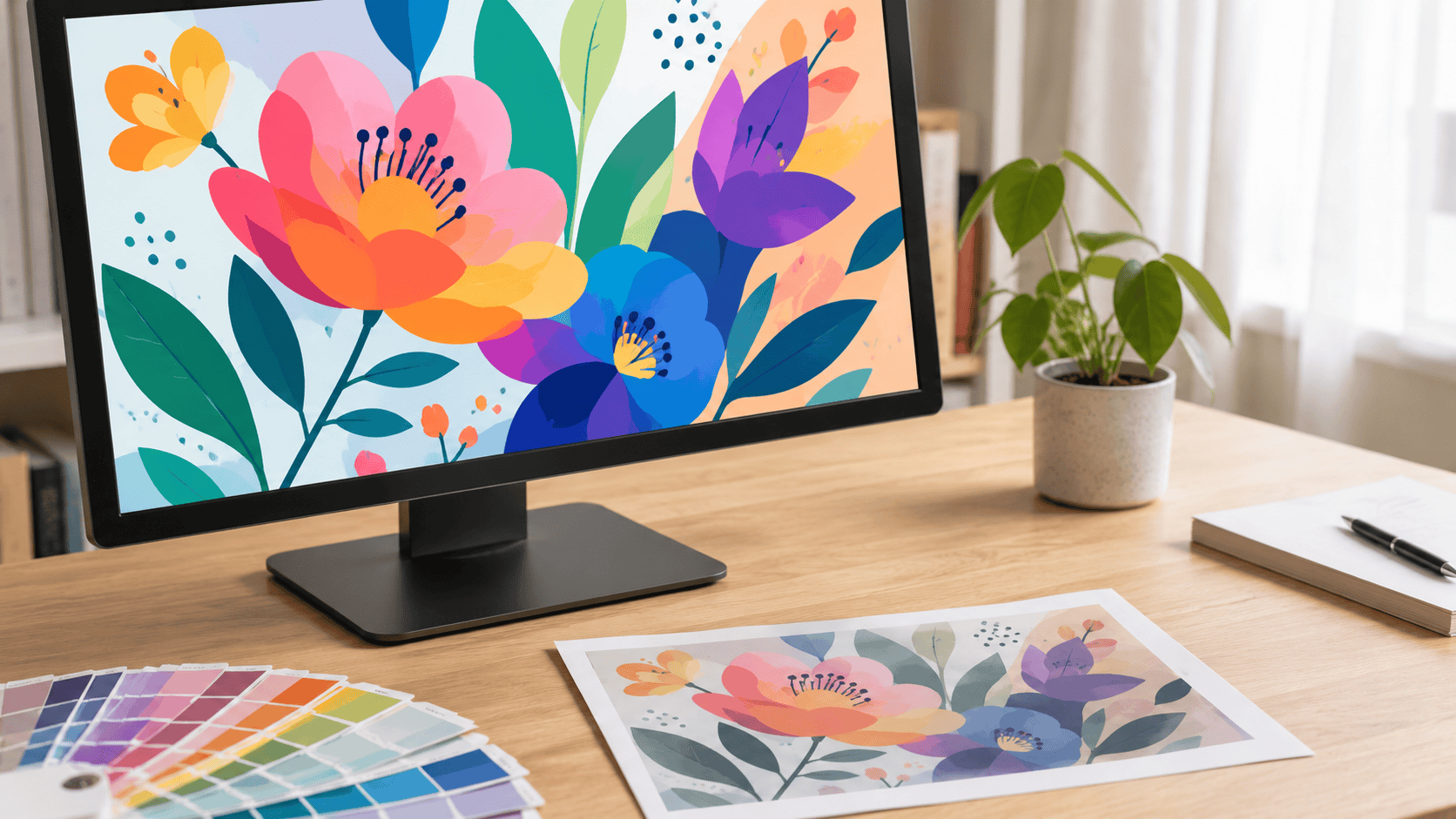
- Use CMYK colours, not RGB. Black text should be 100% K, not a mix of the four colours, for crisp edges.
- Embed your fonts or flatten text to outlines, so nothing re-flows on our RIP.
- Consider creep. On thicker booklets (40+ pages), inner pages trim slightly narrower than outer pages because of the way the spine wraps. Keep important content 6–7 mm in from the trim line for long books.
If you’re not sure whether your file is print-ready, send it in and our pre-press team will flag any issues before we charge you.
Turnaround and delivery in Singapore
Typical Orange Print saddle stitch turnaround times, from approved artwork and payment:
- Up to 1,000 copies, up to 48 pages: 3–5 working days.
- 1,000 to 5,000 copies: 5–7 working days.
- Over 5,000 copies, or with special finishing (lamination, spot UV): 7–10 working days.
Collection is free from our Sembawang production facility at Nordcom 2. Islandwide delivery in Singapore is available at standard courier rates. If you need the booklet on a specific date — for an event, a launch, or a school function — confirm your deadline at the quote stage and we will plan the production window around it.
Frequently asked questions
What is the minimum order for saddle stitch booklet printing?
For offset saddle stitch, the minimum is 300 copies. For smaller runs (1 to 500 copies), use our short-run digital booklet service instead — there is no minimum.
What is the maximum page count for saddle stitch?
Around 64 pages on typical 100–128 gsm body stock. Beyond that, the staples struggle and the centre pages bulge. For anything over 80 pages, switch to perfect binding.
Does the page count really have to be a multiple of four?
Yes. Saddle stitch binds folded sheets, and each folded sheet produces four pages. If your content runs to 14 pages, you must round to 16 — the extra two can be a blank end-leaf, a notes page, or a back-cover continuation.
Can I mix different paper stocks inside one saddle stitch booklet?
The cover can be a different (usually heavier) stock from the body — that’s standard. Mixing different stocks inside the body is rarely worth the cost and complicates the bind. If you need mixed inserts, ask us about alternatives at quote stage.
How long does saddle stitch booklet printing take in Singapore?
Three to five working days from approved artwork for runs up to 1,000 copies, 5–7 days for 1,000–5,000 copies, and 7–10 days above that or with special finishing. Collection is free from Sembawang; islandwide delivery is available.
Is saddle stitch durable enough for a retail catalogue?
For a season (3–6 months of handling on a retail counter) — yes. For longer shelf life or heavy daily use, perfect binding is more durable because the spine is glued rather than stapled.
Can I self-collect from Orange Print?
Yes. Self-collection is free from our Nordcom 2 production facility in Sembawang. You will receive a collection notification by email and WhatsApp once your booklet is ready.
Ready to print your saddle stitch booklet?
Get an instant online quote — choose size, pages, paper, and quantity — on the Orange Print saddle stitch booklet page. If you are not sure which binding is right, reach us on he***@*************om.sg, WhatsApp +65 8438 1313, or the Crisp livechat bubble on the site, and we’ll recommend the best fit for your project.