

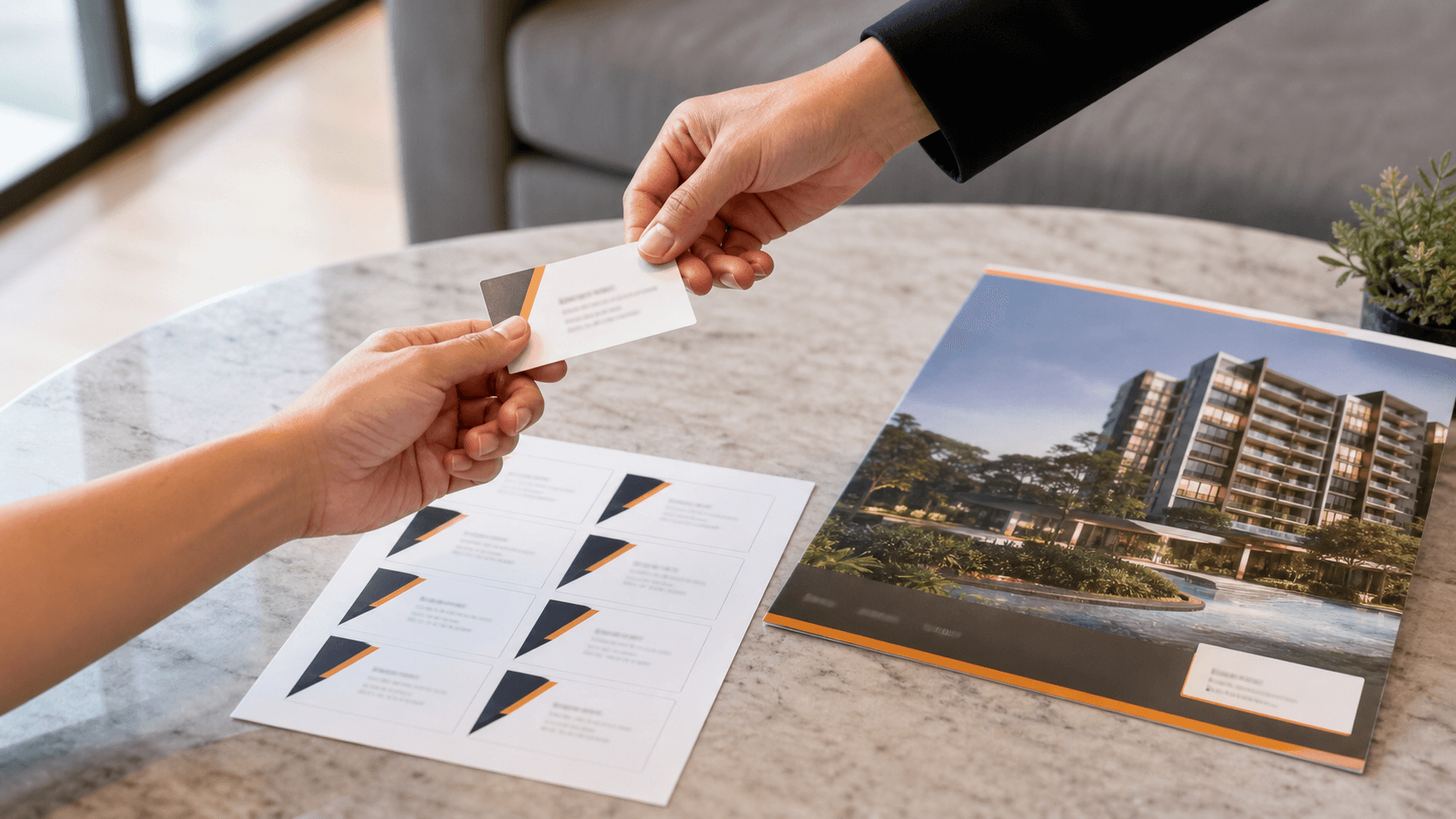

Property agents do much of their marketing online now, but print still has a job when an agent meets someone, hands over developer material or markets a landed property on site. The useful items are not complicated: business cards, personalised contact stickers, selected mailers and compact property banners.
The important question is not how many different products an agent can print. It is which printed item fits the way the agent is actually meeting or reaching the customer.
Key takeaways
- Business cards support conversations, meetings, viewings and referrals.
- Contact stickers let an agent personalise a developer’s flyer or card without reprinting the whole piece.
- Property flyers can still be used, but their distribution must not leave them visible to people other than the intended recipients.
- A3 and A2 banners are practical for a landed property because they can be read on site without becoming an oversized sign.
- Agents can supply completed artwork, or give Orange Print their photograph, name, mobile number and CEA registration number for a basic layout.
Business cards still matter after a conversation
Business cards remain useful because property work is personal. After a conversation, viewing or introduction, a printed card gives the customer the agent’s details in one small item that can be kept, passed to a family member or used for a later referral. It supports the conversation instead of trying to replace it.
An agent may meet a potential seller long before that person is ready to list a property. The name card gives the customer something physical to keep without asking them to search for the agent again.
The card should follow the property agency’s approved layout and current identity requirements. CEA states that property advertisements should identify the property agent by name, CEA registration number and phone number, together with the property agency’s name and CEA licence number. The agent should check that the final card follows the agency’s current requirements before printing.
For a team order, send a checked list for every agent. Photographs, names, mobile numbers and CEA numbers can look correct at a glance even when one digit belongs to an old file. The safest approach is to approve each person’s proof before the cards go into production.
Orange Print can print from finished artwork. If the agent does not have a finished design, we can also prepare a basic layout from the supplied photograph and details. This is a straightforward production layout, not a complete personal-branding exercise.
Contact stickers personalise developer-supplied material
Property agent contact stickers solve a very specific problem. The developer has already printed the project flyer, brochure or customised card, but the individual agent needs the prospect to know whom to contact. A small printed sticker adds the agent’s details without reprinting the developer’s entire piece.
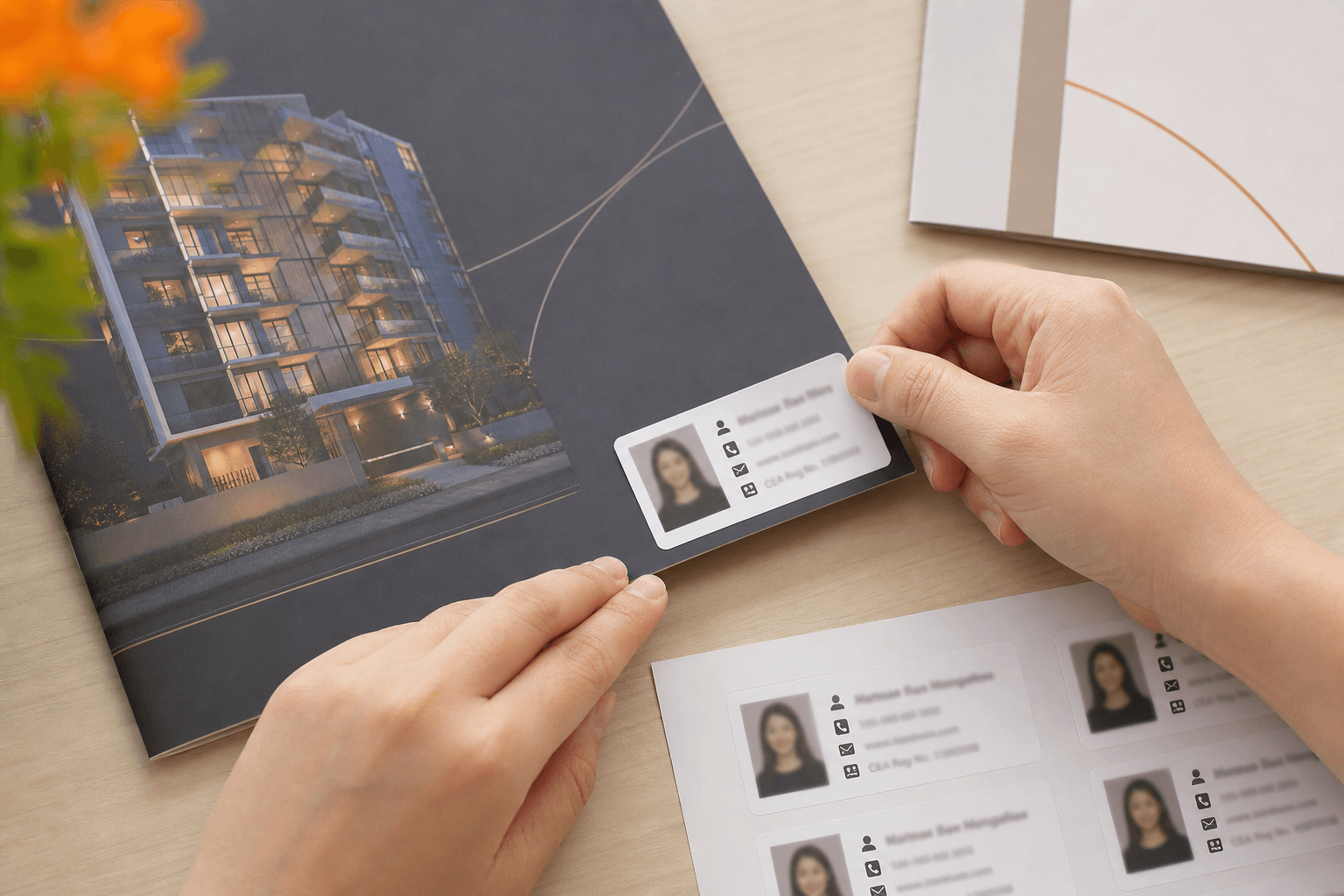
This is different from a general promotional sticker. Its purpose is identification and follow-up.
The agent normally supplies a recent photograph, name, mobile number, CEA registration number and the property agency details required by the approved template.
Some agents already have completed agency-approved artwork. Others send Orange Print the photograph and information for a basic layout. In both cases, the agent should approve the spelling, photograph and numbers before printing.
The sticker size should be chosen only after checking the space available on the developer’s material. It must not cover the project name, price information, disclaimer, QR code or other important content. If several developers use different card or flyer layouts, measure each placement before ordering one large batch.
Kiss-cut sticker sheets are convenient for this use because the agent can peel one label at a time and keep the remaining labels together. The material and finish depend on the supplied artwork, the surface and how the printed piece will be handled. Send Orange Print a photograph or physical sample when the placement is tight.
See Orange Print’s sticker printing guide for an explanation of sheet, kiss-cut and material options.
Flyers are still used, but distribution has changed
Property flyers have not been banned, but the old habit of leaving them visibly at gates and doors is not acceptable. CEA says flyers and pamphlets should only be visible to their intended recipients. Mailbox delivery, addressed mail and properly managed distribution remain possible ways to use printed material.
CEA has advised agents not to leave flyers at gates, on vehicles or where they may create litter. It also recommends mailbox flyering when an agent wants to send hardcopy material to potential clients.
From 1 April 2026, five major property agencies also adopted a clearer industry enforcement framework for flyers delivered to HDB homes. Under that framework, flyers can be placed in mailboxes through SingPost or flyer distributors, but they must not be left visible at doors, gates or common areas.
That does not mean every agent should stop printing flyers. It means the distribution plan should be decided before the print quantity.
An agent targeting a particular estate may still use a simple flyer for mailbox distribution, a postcard-style mailer, a flyer inserted into an envelope for addressed mail, or a small batch for direct handover.
Orange Print prints the material but does not claim to provide a public postage, mailing-list or flyer-distribution service. If another company will handle the mailing or distribution, check its required size, folding, packing and bundling before placing the print order.
The safest quantity is based on a real campaign. Printing a smaller targeted batch is more sensible than ordering a large run with no compliant way to distribute it.
Read CEA’s flyer distribution guidance before planning the campaign.
A3 and A2 banners work at landed properties
A3 and A2 property banners give agents an on-site option for a landed property that is for sale or rent. A3 suits closer viewing, while A2 gives the main message and contact number more space. The banner should be fixed neatly within the property boundary and contain only information that can be read quickly.
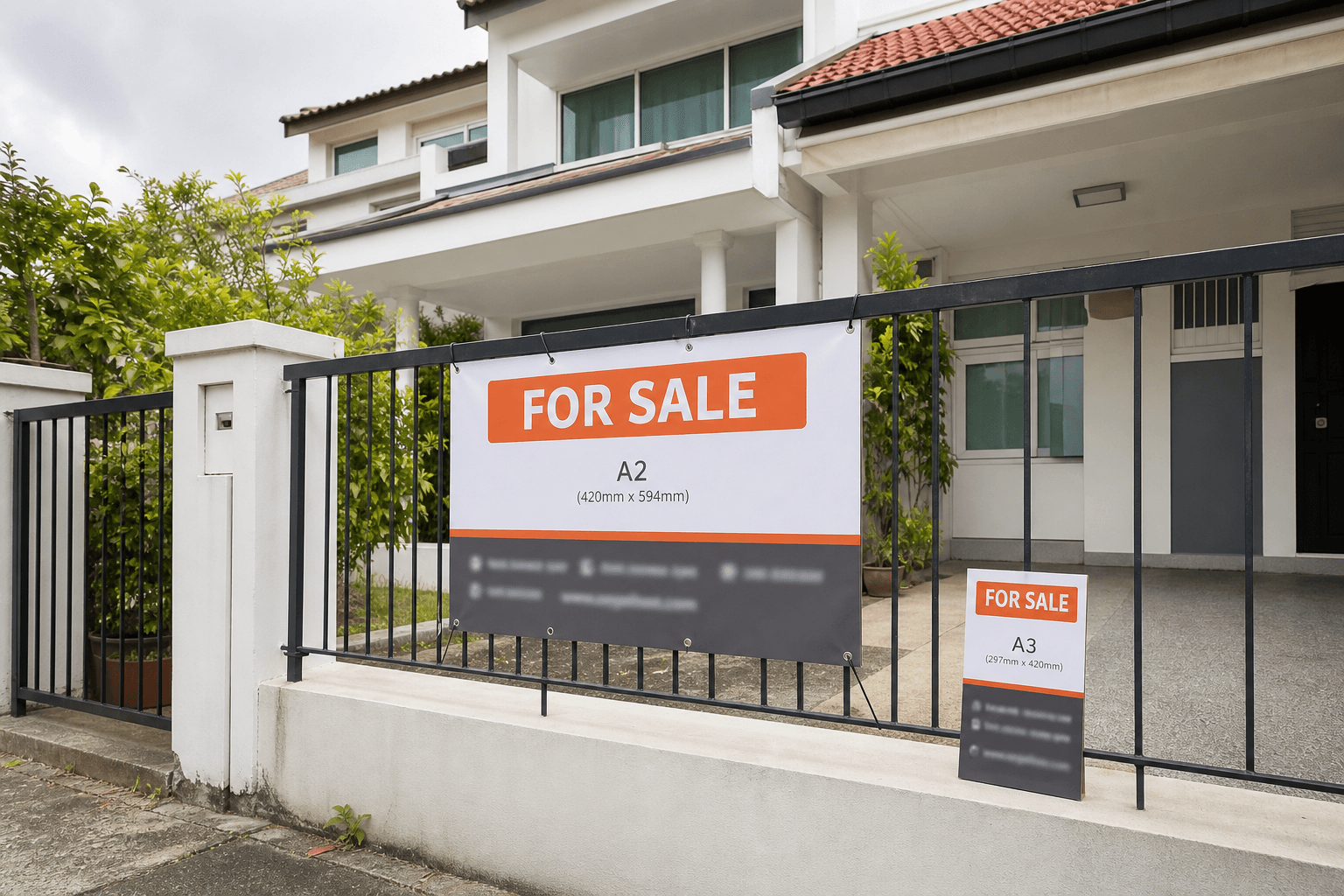
A3 measures 297 x 420 mm. A2 measures 420 x 594 mm. Both are compact compared with a large outdoor billboard, but the artwork still needs a clear viewing order.
The largest text should say what the sign is for, such as “For Sale” or “For Rent”. The agent’s name and mobile number should be easy to find. The CEA and property agency identity details must remain legible, even if they sit in a smaller information block.
URA’s guidance for outdoor signs outside the Central Area permits one real-estate sign at a non-commercial or non-industrial property, mounted on the building wall or boundary wall or fence. The guidance sets a maximum size of 2 square metres and says the sign should be removed within 14 days after the sale, rental or lease.
A3 and A2 are well below 2 square metres, but size is not the only requirement. The owner and agent remain responsible for the placement, content and any approval or licence that may apply. The sign should not extend into a public street, block a pavement or be attached to unrelated public property.
For a quotation, tell Orange Print the size, expected outdoor display period, mounting method, quantity, number of agent versions and deadline. Orange Print can advise on a suitable current print specification after seeing how the banner will be used.
Use one approved identity block across every item
One checked identity block reduces mistakes across business cards, stickers, flyers and banners. It should contain the agent and agency information required by the approved template. Once approved, reuse the same source block instead of retyping the mobile number or CEA registration number for every new item.
The block may include the agent’s photograph, name, registered phone number, CEA registration number, property agency name and CEA licence number. The exact arrangement should follow the property agency’s approved design.
CEA’s Public Register allows customers to verify whether an agent is registered and whether the advertised phone number matches. That makes an old or mistyped number more than a printing error. It can make the material look suspicious to the customer.
Orange Print can check whether the text appears printable and whether the layout fits the chosen item. The agent and property agency remain responsible for the accuracy, approval and compliance of the content.
When an agent changes agency, retire the old files instead of leaving them mixed with current artwork. A file name such as agent-name-sticker-approved-2026-07.pdf is easier to control than final-new-latest.pdf.
What property agents should still print
The most useful property-agent print items are linked to a physical moment: meeting someone, handing over developer material, reaching a particular household or displaying a message at the property. Materials without a clear use are more likely to sit unused or become outdated.
| Print item | Actual use | When it makes sense |
|---|---|---|
| Business card | Given after a conversation, meeting or viewing | The customer needs a small item to keep or pass on |
| Agent contact sticker | Added to a developer’s flyer, brochure or customised card | The developer supplied the main material and the agent needs to personalise it |
| Flyer or postcard | Used for targeted mailbox delivery, addressed mail or direct handover | The agent already has a compliant distribution plan |
| Envelope | Holds a flyer or letter for addressed mail | The agent or mailing provider will handle insertion and postage |
| A3 or A2 banner | Mounted at the landed property being marketed | The owner has agreed and the agent has checked the display requirements |
| Developer flyer or card | Usually supplied by the developer | The agent adds an approved contact sticker instead of reprinting the whole piece |
The list stays limited to items with a clear place in the current agent workflow. A printer’s ability to produce something is not, by itself, a reason to recommend it.
What to send Orange Print for a quotation
A useful property-agent printing quotation starts with the item, quantity, finished size, number of agent versions and deadline. For stickers and banners, also show where the item will be applied or mounted. Orange Print can then quote for the actual job instead of guessing from the words “agent sticker” or “property banner”.
For business cards
- Completed artwork or the agency’s approved template
- Photograph, name, mobile number and CEA registration number
- Quantity for each agent
- Paper or finishing preference, if known
For contact stickers
- Completed artwork, or photograph and agent details for a basic layout
- Desired sticker size
- Photograph or sample of the developer flyer or card
- Quantity
- Sheet or individual-piece preference
For property banners
- A3 or A2 size
- Artwork or information for the layout
- Indoor or outdoor placement
- Expected display period and mounting method
- Quantity and deadline
The agent must approve the final proof. In particular, check the photograph, name, phone number, CEA number, property agency details and any property information before giving the go-ahead.
Frequently asked questions
What should I send for a property agent contact sticker?
Send the completed artwork if your agency already provides it. Otherwise, send your recent photograph, name, mobile number, CEA registration number and required property agency details. Also show where the sticker will sit on the developer’s flyer or card so Orange Print can check the practical size.
Can Orange Print prepare a basic sticker layout?
Yes. Orange Print can arrange a basic layout from the photograph and information supplied by the agent. The agent must check the proof and confirm that the layout follows the property agency’s current requirements before printing.
Are property agents no longer allowed to print flyers?
Property flyers are not banned. They must be distributed so they are not visible to people other than the intended recipients. Mailbox delivery, addressed mail and direct handover can still be used when they follow the applicable rules and property-access requirements.
Can I display an A3 or A2 banner at a landed property?
URA guidance allows a real-estate sign at the property being sold or leased, subject to location, quantity, size and removal requirements. A3 and A2 are below the stated 2 square metre maximum, but the owner and agent should still check the current approval and display requirements before installation.
What should appear on a property agent business card?
Use the property agency’s approved template. CEA guidance for property advertisements identifies the agent’s name, CEA registration number and registered phone number, together with the property agency name and CEA licence number. The agent should approve every detail before the card is printed.
Ask Orange Print about property-agent printing
Send us the item, size, quantity, artwork status and deadline. For contact stickers, include a photograph of the developer material. For a banner, tell us where and how it will be mounted. We will recommend a current production option after seeing the actual use.
WhatsApp Orange Print. We are open Monday to Friday, 9am-5pm. Saturday is by appointment. We are closed on Sunday and public holidays. Singapore-wide delivery is available and quoted per order.