

Printing for online sellers in Singapore often starts with a simple question: what should I print first? Most small sellers do not need a complicated packaging system. They need the right sticker for the right surface, a useful card inside the parcel and, only when the business is ready, custom packaging that fits the product.
The first decision is where the printed item will go. A sticker on the outside of a dry box has a different job from a label attached to an essential-oil bottle.
Key takeaways
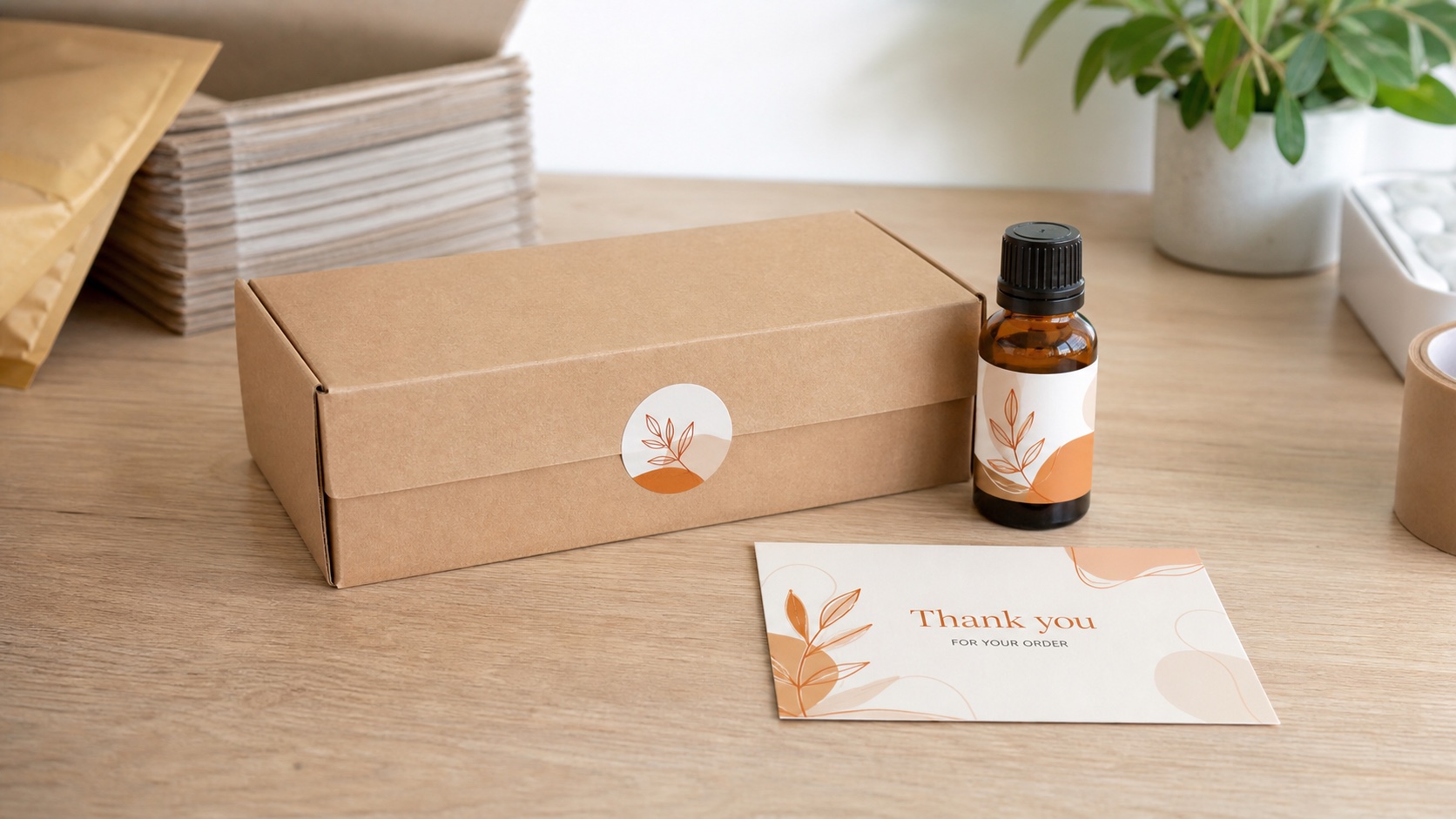
- Use water-resistant mirrorkote for branding stickers, box seals and other packaging applications that do not require a waterproof label.
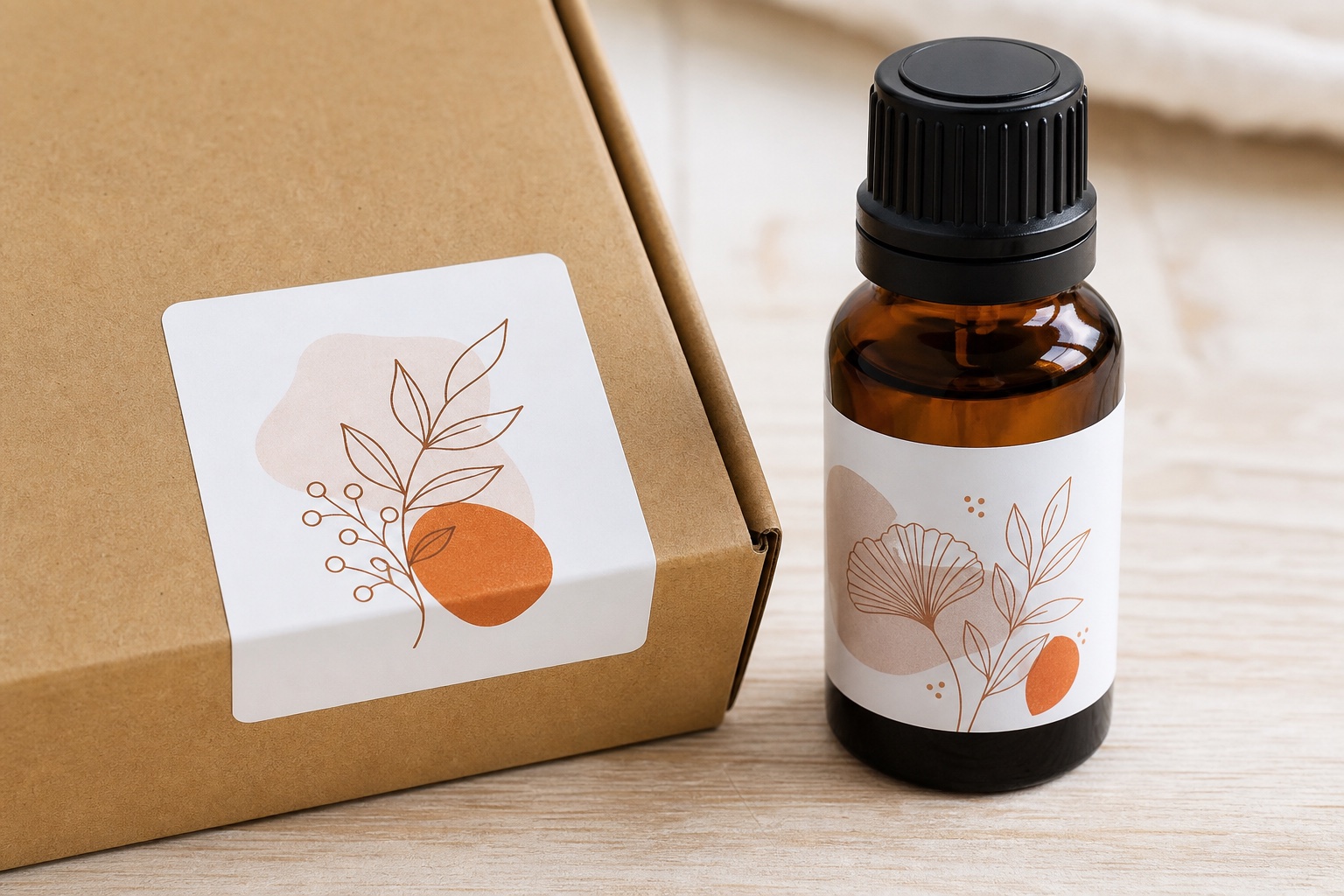
- Use waterproof PP for bottles, jars and product containers. Standard PP is Orange Print's normal recommendation for essential-oil bottles.
- Use waterproof, heat-resistant PET when the label also needs better heat resistance.
- Combine a thank-you message, care instructions and QR code on one card if the layout remains easy to read.
- Consider custom boxes after the product dimensions and recurring order volume have become more stable.
Start with where the sticker will be used
The correct sticker material depends on the surface and its working environment. Before choosing a finish, decide whether the sticker belongs on the outer packaging or on the product itself.
A packaging sticker may sit on a box, mailer or paper bag. Its main job is usually branding, sealing or identifying the parcel. The packaging may remain dry throughout packing, delivery and storage.
A product label stays with the item. It may be handled repeatedly or exposed to water, oil, condensation or heat. It may also need to carry product information that remains readable throughout the product's use.
That difference is more useful than starting with a list of sticker names. It immediately narrows the material choice.
| Printed item | Where it goes | Main job | Practical starting material |
|---|---|---|---|
| Packaging sticker | Box, mailer or paper bag | Branding or sealing | Water-resistant mirrorkote where waterproofing is not required |
| Product label | Bottle, jar or container | Identification and product information | Waterproof PP |
| Clear product label | Transparent bottle or jar | Identification while showing the container | Clear PP |
| Heat-resistant product label | Product or container exposed to heat | Identification requiring water and heat resistance | Waterproof, heat-resistant PET |
Mirrorkote works well for many packaging stickers
Mirrorkote is a water-resistant paper sticker and a practical choice for many outer-packaging applications. Online sellers can use it for a logo sticker on a plain box, a box seal, a thank-you sticker or a branding label on a paper bag.
It is often unnecessary to pay for a synthetic material when the sticker is only going onto dry outer packaging. The seller still gets a printed branding surface without treating every parcel sticker like a product label.
Water-resistant does not mean waterproof. If the parcel may become soaked, sit in a chilled environment or come into regular contact with oil, tell the printer before ordering. The surface coating on the box or mailer also matters, so a photograph or physical sample helps when the application is unusual.
The full Orange Print sticker material guide explains the available sticker families in more detail.
PP is the normal product-label choice for bottles and jars
PP stickers are waterproof and suit product labels that face water, condensation, light oil exposure or repeated handling. Their flexibility also makes them useful on bottles, jars and other curved containers.
For essential-oil bottles, Orange Print normally recommends standard PP rather than automatically moving to strong adhesive. This is the starting recommendation Max has used without receiving customer complaints about the standard PP choice.
Strong adhesive still has a place, but it should solve an actual application problem. The bottle material, coating, curvature, storage condition and any oil left on the surface can affect adhesion. Clean the application area and test the label on the actual container before ordering a large quantity.
Clear PP is another option for transparent bottles or jars. It lets more of the container remain visible, but the artwork must still have enough contrast to be readable against the product behind it.
Sellers can review Orange Print's PP product-label options and send a photograph of the container if they are unsure which finish to choose.
Choose PET when the label also needs heat resistance
PET stickers are waterproof and heat-resistant. PP is also waterproof, but it has lower heat resistance than PET.
That does not make PET the automatic upgrade for every product. A normal bottle label does not need a material feature that its working environment will never use. PET becomes relevant when the product, container or application is genuinely exposed to heat and the label must remain stable.
Tell Orange Print how the finished product will be stored and used. Do not choose from the material name alone. A small material test on the real surface is more useful than assuming every plastic or glass container behaves the same way.
Product use determines what belongs on the label
The sticker material keeps a label attached, but it does not decide the wording the seller must print. Product classification comes first.
This matters for essential oils. Singapore's Health Sciences Authority states that classification depends on the product's intended use and claims. An oil intended for application to the skin may fall within cosmetic-product rules. Essential oils intended for diffusers are listed by HSA as examples that are not cosmetic products.
Where a product is a cosmetic, HSA's current overview lists information that may need to appear in English. This can include the product name and function, directions for use, ingredients, country of manufacture, the responsible company in Singapore, contents, batch number, relevant date information and precautions.
Prepacked food follows a different set of requirements. The Singapore Food Agency states that prepacked food offered for sale in Singapore must comply with the Food Regulations and current food-labelling requirements.
The practical order is:
- Confirm what the product is and how it will be marketed.
- Confirm the information that must appear on its label.
- Work out the label area and readable text size.
- Choose the material based on the container and exposure.
- Test the label on the actual product before a large print run.
Orange Print can help with print size, material and production. The seller remains responsible for the product claims and required label information.
Thank-you cards should do more than say thank you
A parcel insert earns its place when it gives the customer something useful. Besides a short thank-you message, the same card can carry care instructions, a QR code, contact details or next-order information.

Combining these into one card can be neater than placing several small pieces inside the parcel. It also reduces the chance that important care information gets separated from the thank-you message.
The card still needs a clear reading order. If the care instructions are long or safety information must be prominent, give that information enough space instead of forcing everything onto a small card.
Different businesses may use the insert differently:
- Jewellery sellers can add care and storage guidance.
- Candle sellers can include safety and use instructions.
- Craft sellers can explain assembly or handling.
- Skincare and essential-oil sellers can include suitable use instructions without replacing information that must remain on the product label.
- Gift sellers can add a short message or QR code linking to product information.
A card should not promise rewards for positive reviews or make claims that conflict with the seller's marketplace rules. Its job is to help the customer, not to pressure them.
Orange Print has a dedicated thank-you card printing page for sellers who are ready to choose a size and paper option.
Plain boxes plus stickers can be the right starting point
Custom printed boxes can give a product a more complete branded presentation, but they are not always the first item a new seller should order.
A plain box with a mirrorkote branding sticker may make more sense while the seller is testing product sizes, bundles or seasonal sets. It is easier to change a sticker than to replace a stock of boxes after the product dimensions change.
Custom boxes become more practical when:
- The product dimensions are stable.
- The seller has a recurring packing format.
- The same box will be used often enough to justify dedicated packaging.
- The artwork and required product information are unlikely to change immediately.
The box structure, dimensions, quantity and intended contents all affect the quotation. Orange Print should review the actual job before stating a minimum order or production schedule. Sellers can browse the custom packaging options and then ask for a quotation based on their product.
Choose label sheets or rolls around the packing process
Sticker sheets are straightforward for small batches applied by hand. The seller can keep several labels together, peel them one at a time and store the remaining sheet flat.
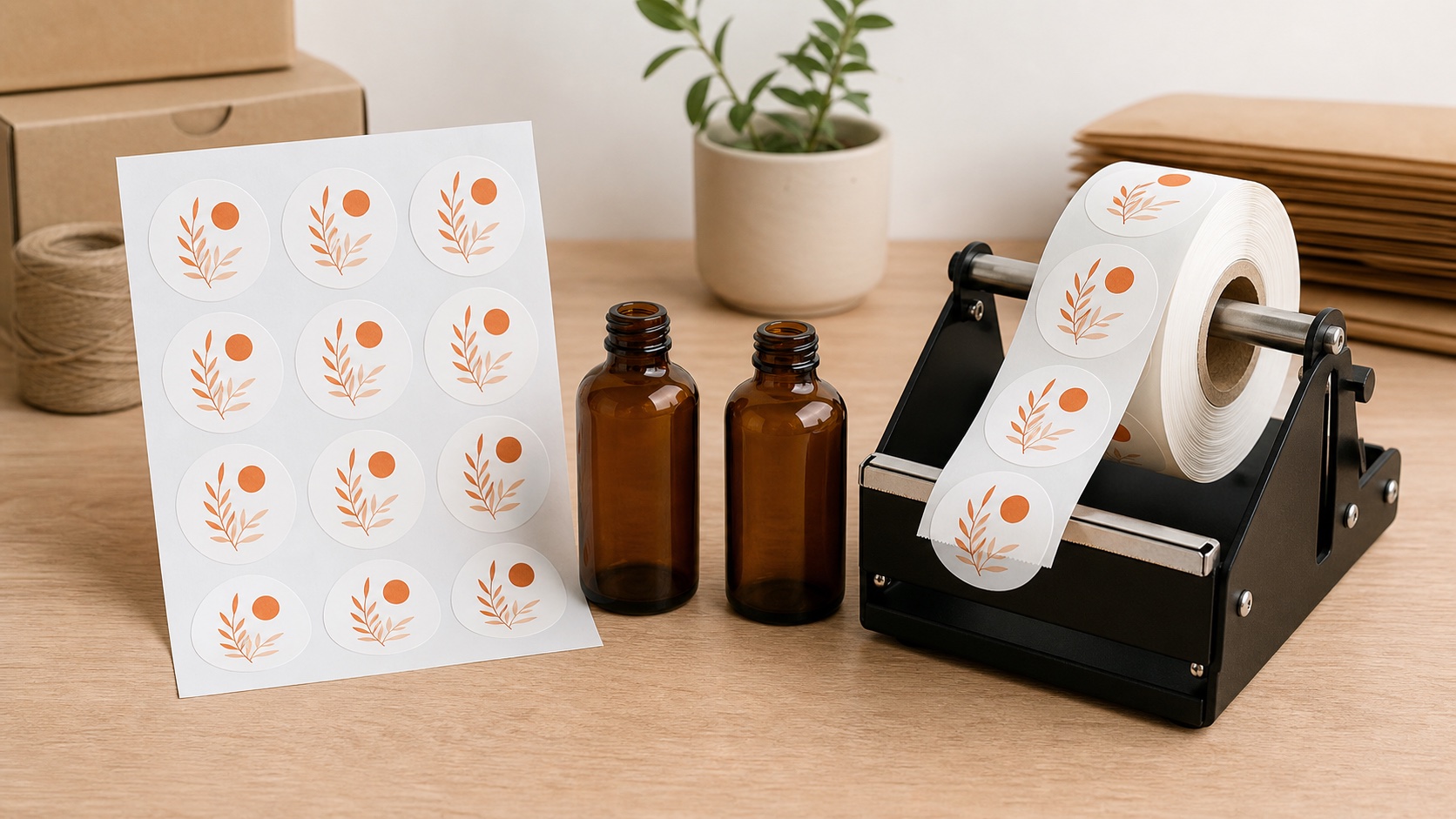
Roll labels may make more sense when labels are applied repeatedly as part of a packing or production routine. The roll format can be easier to handle at a workbench or may suit a label-dispensing process.
There is no single quantity at which every seller should switch. Label size, roll direction, application method, number of designs and packing speed all affect the decision. Describe the current workflow instead of ordering rolls simply because the business expects to grow.
Orange Print's roll-form label page shows the relevant ordering route. Ask for advice if you are moving from manual sheet application to a repeated labelling process.
A simple print kit for different online sellers
A useful starter kit depends on what is being sold. Each printed item should have a clear job.
| Seller type | Useful starting items | Main decision |
|---|---|---|
| Apparel, gifts or dry goods | Packaging logo sticker and thank-you or care card | Mirrorkote may be enough for the outer packaging |
| Essential-oil or skincare seller | PP product label and instruction card | Confirm the product classification, label content and bottle surface |
| Prepacked-food seller | Product label and suitable outer packaging | Check current SFA labelling requirements before finalising artwork |
| Handmade craft seller | Packaging seal and care or assembly card | Keep instructions readable and easy to retain |
| Seller with stable recurring products | Product labels, parcel inserts and custom boxes | Confirm dimensions and quantities before committing to dedicated packaging |
Printing every possible insert does not make the parcel better. Start with the item that solves the clearest problem, then add another only when it improves identification, protection or customer instructions.
What to send Orange Print for a quotation
A useful quotation begins with the application, not just the words "I need stickers". Send Orange Print:
- What the sticker, card or box will be used for
- A photograph of the box, bottle, jar or container
- The finished size or available label area
- Quantity and number of designs
- Whether the item faces water, oil, condensation, refrigeration, heat or rough handling
- Whether labels will be applied from sheets, rolls or a machine
- Artwork status
- Required completion date
For product labels, include the container material and a sample if possible. For custom boxes, include the product dimensions, packed weight and how the item will sit inside the box.
These details let Orange Print recommend a current material and quote for the actual use instead of guessing from a product name.
Frequently asked questions
Should an online seller use mirrorkote or PP stickers?
Use water-resistant mirrorkote for packaging stickers, box seals and paper bags where a waterproof label is not required. Use waterproof PP when the label goes onto a product bottle, jar or container that may face water, condensation, light oil exposure or repeated handling.
What sticker should I use on an essential-oil bottle?
Orange Print normally recommends standard PP for essential-oil bottles. PP is waterproof and suitable for product labels on bottles and jars. Confirm the bottle surface and product use, clean the application area and test the label on the actual bottle before a large order.
When should I choose PET instead of PP?
Choose PET when the label needs to be waterproof and heat-resistant. PP is waterproof but has lower heat resistance than PET. The actual product, surface and exposure should decide the material.
Can one thank-you card also contain care instructions and a QR code?
Yes, if every part remains easy to read. A single card can carry a thank-you message, care instructions, contact details and a QR code. Use a larger card or a separate instruction card when safety or product information needs more space.
Should I order sticker sheets or roll labels?
Sheets suit many small batches applied by hand. Rolls may suit repeated application or a production workflow. The right format depends on label size, quantity, application method and how the roll must feed, so there is no universal changeover quantity.
When should an online seller consider custom printed boxes?
Consider custom boxes when the product dimensions and packing format are stable and the same box will be used repeatedly. A plain box with a printed branding sticker can remain the more flexible option while the seller is still testing products or bundle sizes.
Ask Orange Print about online-seller printing
Send us a photograph of the product and packaging, the required size, quantity, artwork status and deadline. Tell us if the label will face water, oil, condensation or heat. We can then recommend mirrorkote, PP, PET or another current option based on the actual application.
WhatsApp Orange Print. We are open Monday to Friday, 9am-5pm. Saturday is by appointment. We are closed on Sunday and public holidays. Singapore-wide delivery is available and quoted per order.