


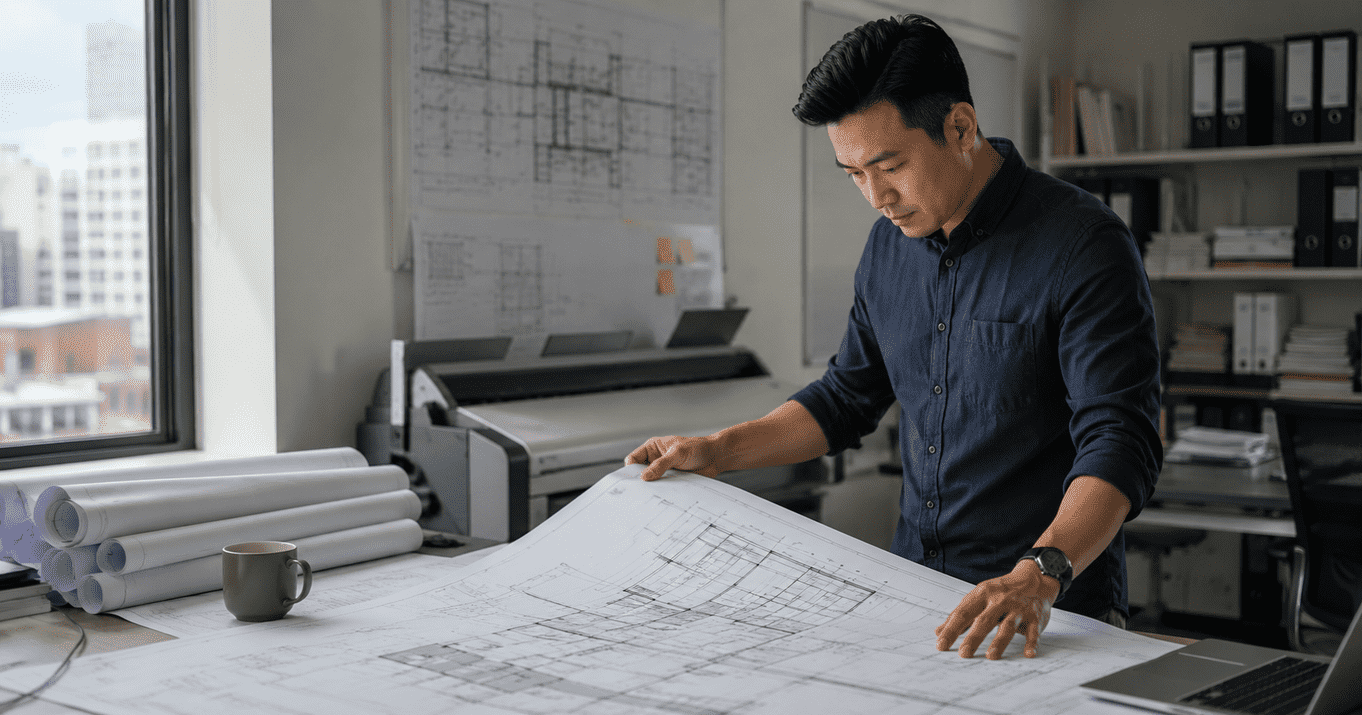

Most architecture and engineering firms in Singapore still have a drawer, a tube or a shelf somewhere full of rolled up plans. Old site drawings, superseded CAD sets, survey plans from a decade ago. Physical copies that nobody wants to lose but that are getting harder to store, share or reprint every time someone needs a copy.
This is exactly what large format scanning solves. Instead of keeping a fragile paper original as your only record, you scan it once into a clean digital file, and from then on you can email it, archive it, or send it back to plot printing whenever you need a fresh physical copy.
What large format scanning actually is
Large format scanning is the process of converting oversized physical documents, meaning A0, A1 and A2 architectural plans, engineering drawings, surveys, maps and artwork, into digital files such as PDF, TIFF or JPEG. It is a different service from regular document printing, because the equipment needs to handle sheets far bigger than a standard A4 scanner or photocopier can take.
Architects, M&E and civil engineers, surveyors and construction teams typically use this service for one of three reasons. Digitising an existing drawing set for archiving, sharing a plan with a client or contractor who needs a digital copy, or reprinting an old drawing that only exists on paper.
How it works, in plain terms
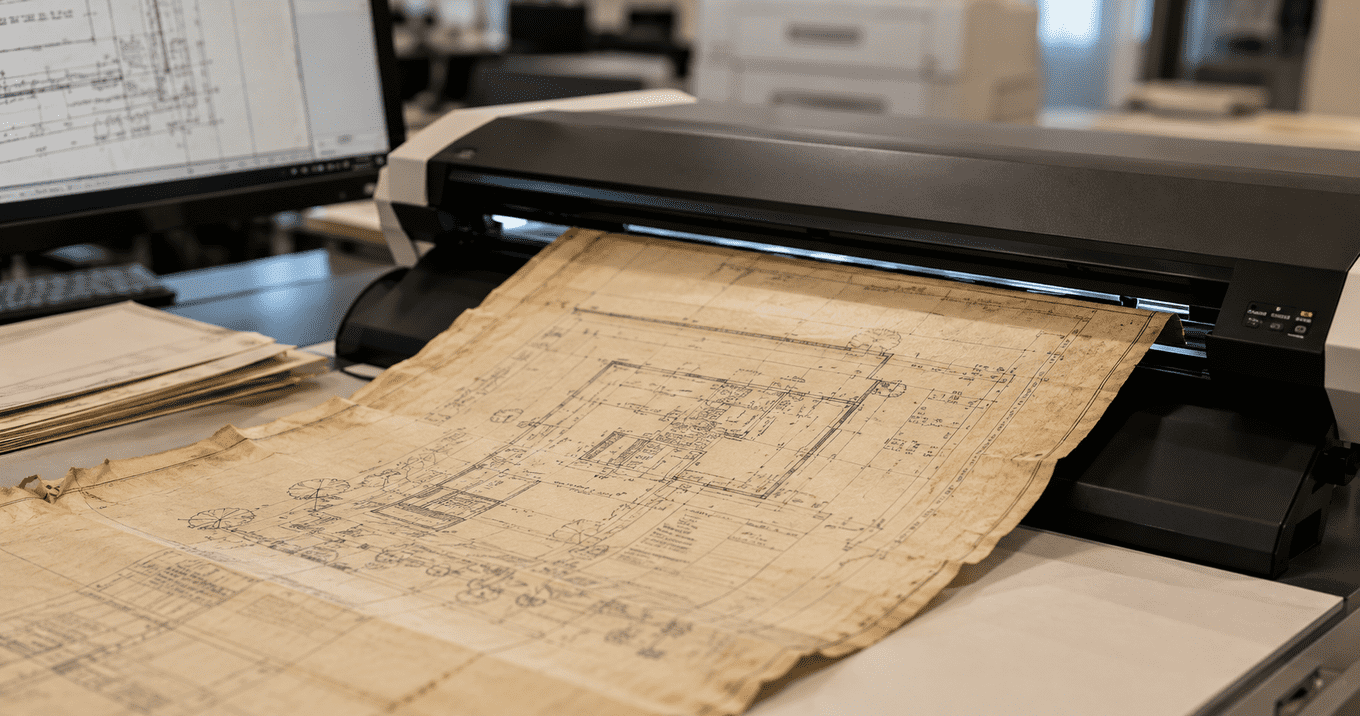
A large format scanner works like a bigger version of the scanner attached to your office printer. The original sheet feeds through, and the machine captures it at high resolution, usually 300 dpi as the standard for CAD plans and technical drawings. Higher resolutions, around 600 dpi or more, are available for finer artwork reproduction.
Because scanning and plot printing often run on the same multi-function large format machine, it is possible to scan an old drawing and get a fresh printed copy of it in a single visit. This is useful if you are trying to revive a set of plans that are too worn or faded to submit as is.
Choosing between PDF, TIFF and JPEG
- PDF tends to be the most common choice for CAD plans and general archiving, since it is easy to share and view across most software.
- TIFF offers reproduction grade quality, which is useful for artwork or plans that will be reprinted later.
- JPEG produces the lightest file size and works well for quick sharing and review copies where full print quality is not the priority.
If you are not sure which one you need, PDF is usually the safe default for most architectural and engineering use cases.
What affects the cost
Three things move the price on a scanning job more than anything else, sheet size, colour, and how many sheets arrive at once. Batch size is the one people underestimate. A firm that scans five drawings this month, five next month and five after that usually pays more in total than a firm that waited and scanned all fifteen together, since each small order gets billed on its own rather than as one combined batch.
| Size | Black and White | Colour |
|---|---|---|
| A2 (420 x 594 mm) | from S$1.30 per sheet | from S$2.40 per sheet |
| A1 (594 x 841 mm) | from S$2.20 per sheet | from S$4.00 per sheet |
| A0 (841 x 1189 mm) | from S$3.30 per sheet | from S$6.00 per sheet |
Sheet condition plays a quieter role in cost, even though it rarely shows up on a rate card. A flat, clean drawing feeds through in seconds. A drawing rolled for years and prone to curling takes longer to flatten and hold steady, and a careful provider will slow down for that rather than risk soft, blurred edges near the fold lines.
Delivery and turnaround
A site engineer who just needs to check a dimension on his phone wants a quick link, while a project coordinator archiving a full drawing set wants files named and grouped consistently, so nothing gets buried six folders deep a year later. It helps to say which of these you are before the job starts, since it changes how the output gets organised.
Turnaround can also depend on where in the week a job lands rather than just how many sheets are in it. A batch dropped off Friday afternoon competes with everyone clearing their desk before the weekend, while the same batch on Monday morning tends to move faster simply because of queue position. If your deadline is fixed, such as a tender closing date, it is worth saying so upfront rather than after the job is already queued, since most scanning teams can reorder priority once they know a hard date exists.
How Orange Print handles large format scanning
At Orange Print, large format scanning is done entirely in house at our Sembawang facility, so your originals never leave our premises. We scan A2, A1 and A0 sheets on a Canon imagePROGRAF TZ-5320, a multi function large format unit, in black and white or full colour at 300 dpi, with 600 dpi and above available for finer artwork on request.
Because the same machine handles scanning and plot printing, Orange Print can scan an old drawing and reprint a fresh copy in a single visit. Standard turnaround is two to three working days, with same day and rush scanning available if you flag it when you enquire. Files are delivered through a private download link by default, with a thumb drive available on request. WhatsApp Orange Print or use the live chat on the site to confirm capacity for a larger batch.
Large format scanning rarely happens in isolation. A firm digitising an old drawing set is often, in the same week, also sending new drawings out for plot printing, whether that is an A1 printing job for a submission set or a full A0 print for a site board. Working with Orange Print for both scanning and plot printing means your originals and your reprints go through the same facility, which cuts down on back and forth and keeps everything under one collection point.
If your office also handles project documentation beyond drawings, such as meeting minutes, reports and tender documents, it is worth checking whether Orange Print’s document printing Singapore service can handle those files too, so you are not juggling two separate vendors for one project.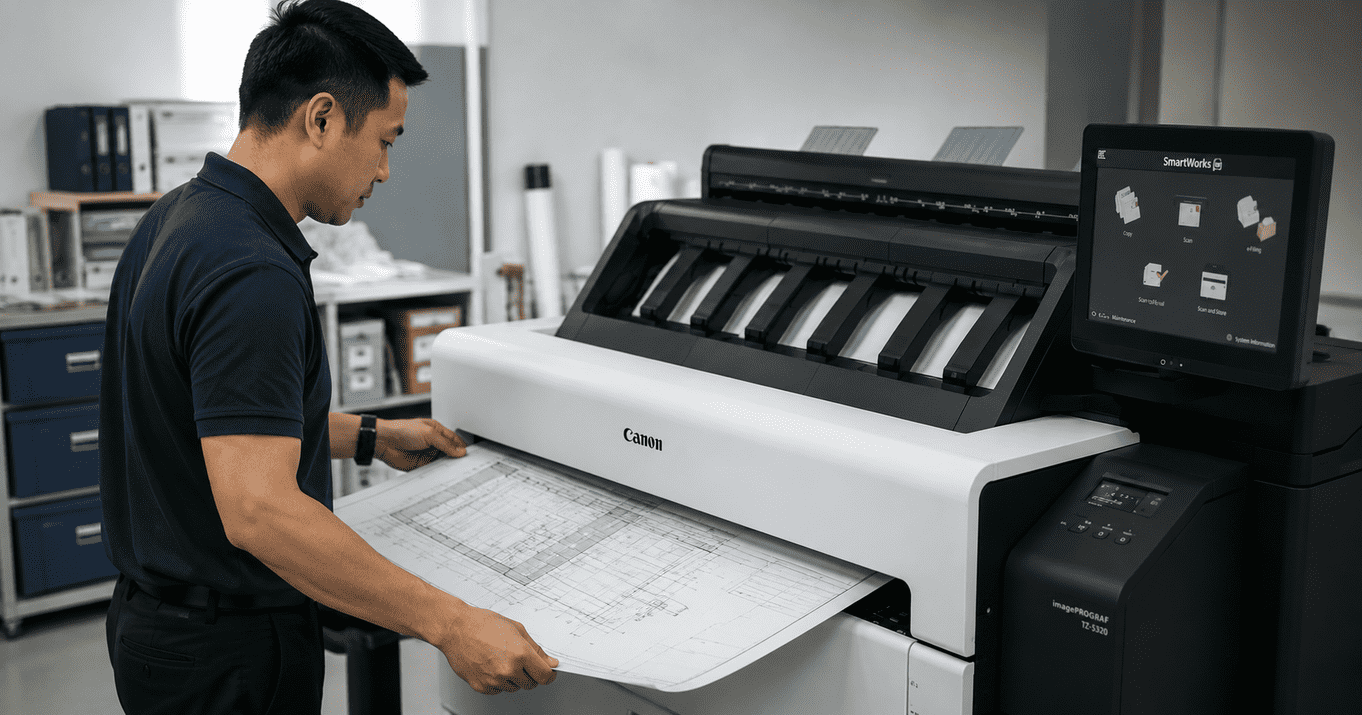
Frequently asked questions
1. What is the difference between large format scanning and regular document scanning?
Regular scanners are built for A4 or A3 paper. Large format scanning uses equipment built to handle A2, A1 and A0 sheets, the sizes typical for architectural plans and engineering drawings, without folding or cutting the original.
2. Can old, faded or torn drawings still be scanned?
Most originals can be scanned as is at Orange Print, though very fragile or torn drawings may need extra care during feeding. It is worth mentioning the condition of your originals when you enquire so the scanning service can handle them appropriately.
3. Do I need to know the exact number of sheets before ordering?
No, most scanning services can start with an estimated quantity and adjust the final cost based on the actual sheet count once the job is counted and scanned.
4. Can scanned drawings be converted into editable CAD files?
Raster to CAD conversion, meaning turning a scanned image into an editable DWG or DXF file, is usually available as a separate, custom quoted service, since it involves more manual tracing work than a straightforward scan.
5. How long are digital files kept available after scanning?
At Orange Print, download links stay active for around thirty days, after which it is worth saving a local copy or requesting the files again.
6. Is there a minimum order for large format scanning?
Most scanning services do not require a large minimum. At Orange Print, a handful of sheets can be scanned just as easily as a full archive box, though a small minimum charge may apply to cover the setup for very small jobs.