


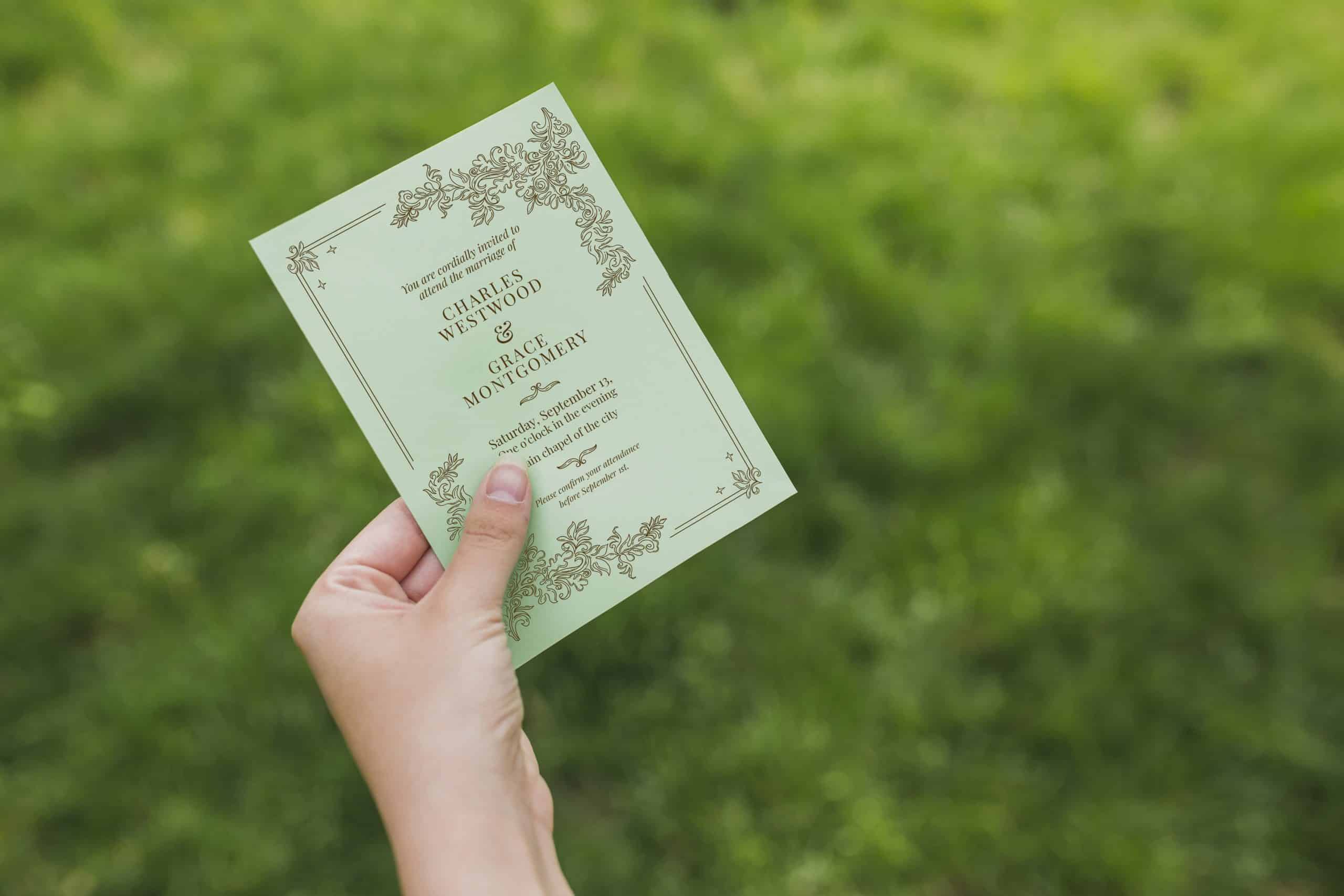

Even in a time when RSVPs, maps, and wedding updates are often shared online, printed wedding invitations still hold value. A beautifully printed invite feels more personal, more memorable, and honestly, a lot harder to ignore than a link lost in someone’s messages. It also makes life easier when you’re sharing details with parents, grandparents, and relatives who appreciate something they can actually hold in their hands. Long after the wedding is over, the invitation often becomes one of the few printed pieces couples keep in a box, frame in an album, or revisit years later.
The invitation often gives guests a first glimpse of the celebration, whether the vibe is elegant, modern, romantic, or quietly understated. The paper, colours, and design choices all help set the tone before anyone even arrives at the venue. That’s why the quality of wedding invitation printing matters, so the card reflects the exact vibe you want to create. Orange Print is here to help you turn your wedding invitation ideas into beautifully printed cards that feel personal, look refined, and reflect the exact tone you want to convey.
Wedding Invitations In Singapore: A Practical Guide To Paper Types, Pricing And Design
Your wedding invitation is often the first glimpse guests get of your celebration. From paper type and printing cost to layout and wording, each detail plays a part in how your invitation looks, feels, and leaves an impression on your guests.
a) Common Wedding Invitation Paper Types in Singapore
Choosing the right paper is one of the most important decisions when planning your wedding invitations. The paper affects how the invitation looks, how it feels in the hand, and how well the design prints. Even with the same artwork, different paper stocks can create very different impressions. Some papers highlight colours and images, while others emphasise texture and elegance. Understanding these differences can help couples choose materials that match their wedding style and budget.
Below are some of the most common paper types used for wedding invitations in Singapore and what they are best suited for.
1. Art Card / Art Paper
Art card and art paper are among the most commonly used materials for wedding invitations because they offer a smooth, polished surface that prints clearly and consistently. The smooth finish allows colours, graphics, and photographs to appear sharp and vibrant.
Key characteristics:
- Smooth and even surface
- Excellent for colour printing and detailed artwork
- Often available in glossy or semi-gloss finishes
Because it is widely available and easy to print on, art cards are often considered a practical and budget-friendly option. It works especially well for invitations that include illustrations, floral graphics, or photo-based layouts.
2. Matte Card
Matte cards are similar to art cards but without the glossy coating. Instead of reflecting light, it offers a soft, understated finish that many couples find elegant and timeless.
Key characteristics:
- Non-gloss, smooth finish
- More subtle and sophisticated appearance
- Reduces glare, making text easier to read
- Suitable for simple and elegant designs
Matte cards are often chosen for minimalist wedding invitations where the focus is on typography and layout rather than heavy graphics.
3. Textured Paper
Textured paper adds a tactile element that instantly makes invitations feel more premium. Instead of a perfectly smooth surface, the paper features subtle patterns or fibres that give it character.
Key characteristics:
- Often used for premium or luxury invitations
- Adds depth and warmth to simple designs
Textured paper works best when the design is clean and uncluttered. Too many graphics can compete with the texture, so it is often recommended to choose simple layouts that allow the material itself to stand out.
4. Kraft Paper
Kraft paper is known for its natural brown colour and rustic charm. It is often used for weddings that embrace a casual, outdoor, or earthy theme.
Key characteristics:
- Natural, recycled-looking brown paper
- Rustic and organic appearance
- Works well with simple typography and minimal graphics
This paper pairs well with dark ink colours such as black or deep green. It is especially popular for rustic, bohemian, or garden-style weddings.
5. Pearl / Metallic Paper
Pearl or metallic paper adds a subtle shimmer that reflects light and creates a luxurious finish. It is often chosen by those who want their invitations to look and feel more glamorous.
Key characteristics:
- Slight shimmer or pearlescent effect
- Reflects light softly for an elegant appearance
- Creates a premium and refined look
Because the paper already has a decorative finish, designs printed on pearl paper are often kept relatively simple to avoid overwhelming the overall appearance.
b) Wedding Invitation Printing Costs in Singapore
Understanding the cost of wedding invitations can help you plan more confidently and avoid surprises later on. While there is no single fixed price for every order, the total usually depends on a mix of material choices, print specifications, and extra finishing details. In Singapore, wedding invitation printing costs can vary widely depending on your preferred style. That is why it is worth looking at the key cost factors, the features included at different budget levels, and how to cut costs while still maintaining a good presentation.
What affects the cost?
1. Quantity Ordered
i) The number of invitations printed has a direct impact on cost.
ii) Printing more pieces at one time can often lower the cost per card.
iii) Smaller orders may seem simpler, but they can be less cost-efficient on a per-unit basis.
2. Paper type and thickness
i) Standard paper stocks are usually more affordable than textured or speciality papers.
ii) Thicker cards often feel more premium, but they also raise the overall price.
iii) Speciality stocks such as pearl or metallic paper usually cost more than basic smooth cards.
3. Size of the invitation card
i) Larger cards generally use more material and may cost more to print.
ii) Unusual or custom sizes can also increase production costs.
iii) Standard sizes are often more economical and easier to match with envelopes.
4. Single-sided vs double-sided printing
i) Single-sided cards are usually more cost-effective.
ii)Double-sided printing adds space for more information, but it also increases print cost.
5. Add-ons like envelopes, inserts, RSVP cards, stickers
i) Extra pieces can elevate the overall presentation, but each added item increases the total.
ii) Matching envelopes, RSVP cards, and inserts are common upgrades for more complete invitation suites.
iii) Decorative details such as stickers can also add to the cost.
6. Special finishes such as lamination, foil, embossing, or die-cutting
i) Finishing options can make invitations look more refined or luxurious.
ii) Foil stamping, embossing, and die-cutting usually cost more because they involve added production work.
iii) Even simple lamination will increase your budget.
7. Custom design work vs print-ready artwork
i) If you already have artwork prepared correctly for print, production is often more straightforward.
ii) If you need design support, layout adjustments, or custom artwork, those services may add to the final cost.
iii) Orange Print can support you with both print-ready files and customised design assistance, helping you manage artwork requirements more smoothly while keeping revisions and extra costs to a minimum.
Also, looking at invitation costs in tiers can give you a clearer sense of what to expect at each budget level. Basic options usually include a simple card design on standard stock with straightforward printing and no extra finishing, while mid-range invitations often feature thicker paper, double-sided printing, matching envelopes, and a more polished overall presentation. Premium invitations typically use textured or speciality paper with finishes such as foil, embossing, lamination, or extra inserts.
c) Wedding Invitation Design Tips
Start with the wedding theme:
Your invitation design should reflect the overall style of your wedding, whether it is modern, minimal, floral, traditional, rustic, or elegant black-tie. Starting with a clear theme makes it easier to choose the right colours, fonts, layout, and decorative elements.
Prioritise readability:
The most important details, such as the couple’s names, wedding date, time, and venue, should stand out clearly at first glance. Avoid overly decorative fonts for body text and leave enough spacing so the card feels clean and easy to read.
Choose colours that print well:
Soft neutrals can create an elegant and timeless look, while richer tones often work well for more formal wedding styles. It is also important to avoid low-contrast text on busy backgrounds, as this can make the invitation harder to read once printed.
Keep the wording concise:
The main card should include only the key details guests need to know right away. If there is extra information such as RSVP instructions, directions, or event notes, these can be placed on inserts, a QR code, or a wedding website.
Use high-resolution artwork:
Photos, logos, monograms, and illustrations should be high resolution so they print clearly and do not appear blurry or pixelated. Files should also be prepared properly for print to avoid unexpected issues with sharpness, alignment, or colour output.
Don’t forget practical details:
A well-designed invitation should also include practical details such as the RSVP deadline, dress code, map or parking information, and bilingual wording where needed.
Popular Wedding Invitation Sizes And Formats:
The size and format of your wedding invitation affect both how it looks and how it functions. Choosing the right format can help you present your details clearly while keeping the overall design practical for wedding invite printing.
- Standard flat card: A standard flat card is one of the most popular formats because it is simple, clean, and easy to read. It works well if you want a straightforward invitation layout without too many extra elements.
- Folded invitation: A folded invitation gives you more space to organise information across different panels. It is a good option if you want a slightly more formal presentation or need room for additional wording and design details.
- Multi-card suite: A multi-card suite includes separate pieces such as the main invitation, RSVP card, and detail card. This format is ideal for weddings that require more information but still want the overall set to look organised and polished.
- Postcard-style invitation: A postcard-style invitation offers a compact and minimal format that feels contemporary.
However, standard sizes are usually easier to print, package, and match with ready-made envelopes, which can help reduce costs and simplify production.
Plan Your Wedding Invitations Early For A Smoother Printing Process:
It is best to start planning your wedding invitations at least three to four months before the wedding so you have enough time for design, proofing, printing, and delivery. This gives you room to review the layout properly, make changes where needed, and avoid rushing important decisions. A clear timeline also helps if you need to adjust your guest list at the last minute or add matching items such as inserts, envelopes, or even custom paper bags. Besides, working with a local printing company can also make the entire process smoother from start to finish. A reputed local printing shop in Singapore offers faster communication, easier proofing, and more dependable delivery timelines.
Orange Print helps you with design adjustments, print preparation, and production guidance tailored to local wedding needs, making it easier to create invitations that look polished and arrive on time. Get a quote today.