


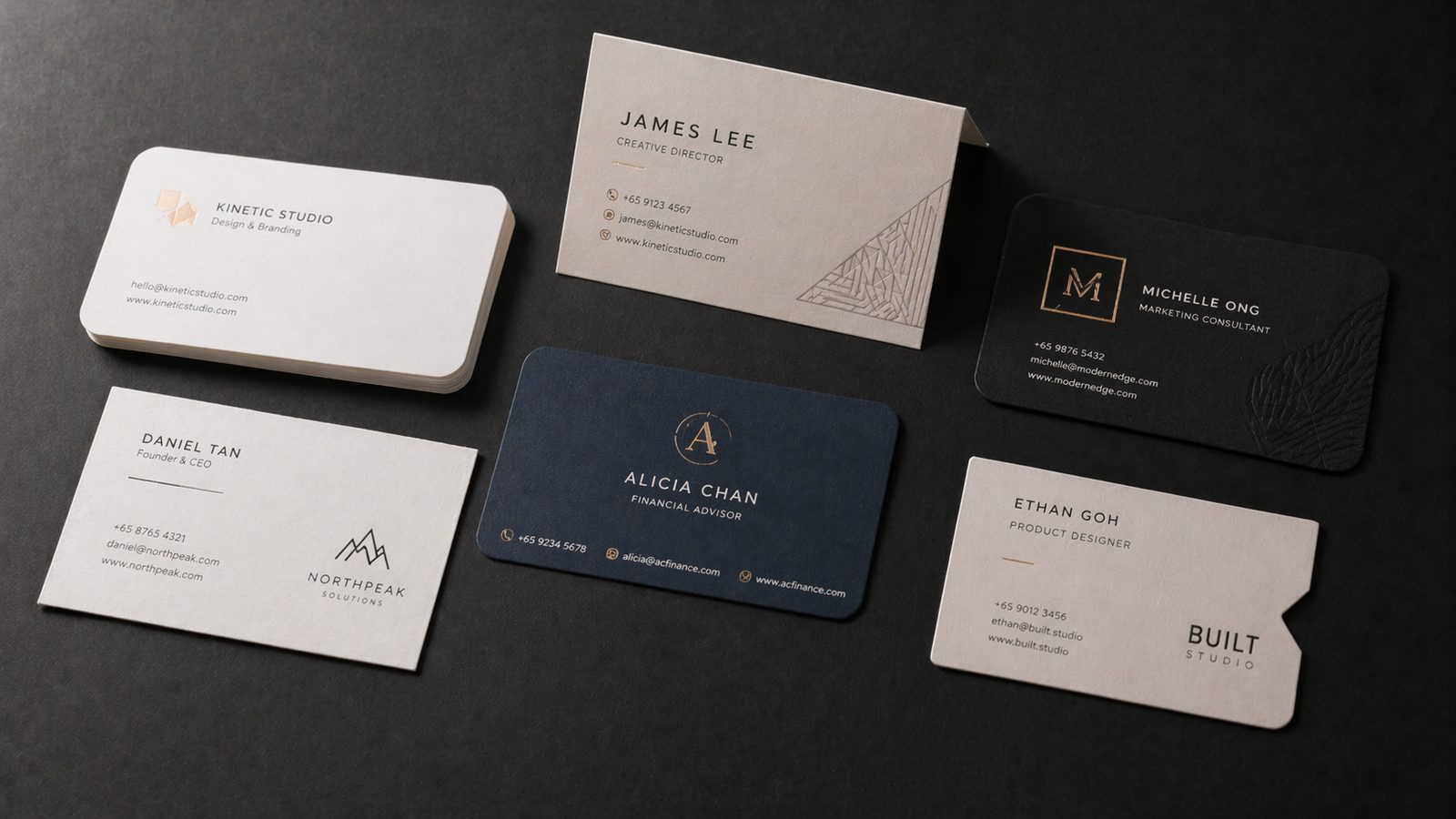

Your business card is the smallest piece of print you’ll ever hand someone — and often the only one they’ll keep. Choosing the right business card printing in Singapore isn’t just about price per card; it’s about the paper weight someone feels in their hand, the finish they see under the lights at a coffee shop, and whether the card survives a week in a wallet. This guide walks through every meaningful choice — standard vs folded vs die-cut, paper and finish, quantity, turnaround — so you can order with confidence.
Key takeaways
- Standard 90 x 54 mm is the safe default for Singapore; it fits every cardholder.
- 310–350 gsm art card is the sweet spot for feel without feeling stiff.
- Matte lamination looks more premium; glossy makes colours pop.
- Folded cards give you 4 panels — great for menus, loyalty cards or longer bios.
- Die-cut cards (rounded or custom shape) lift the perceived value with almost no cost increase.
- Express digital printing turns around in 1 working day when you’re running short.

What is business card printing, and what decisions actually matter?
Business card printing in Singapore is the process of producing small, pocket-sized cards — typically 90 x 54 mm — with your name, role, company and contact details. Beyond the design, the decisions that actually affect how your card is received are the paper stock, the finish, the card shape and the print process. Get those four right and a simple design will feel more expensive than a complicated one on thin paper.
At Orange Print, we offer four main variants: standard rectangular cards, folded cards with extra panels, die-cut cards in custom shapes, and express digital cards for same-day or next-day needs. The rest of this guide helps you pick between them.
Choosing the right size and shape
In Singapore, the standard business card size is 90 mm x 54 mm, almost identical to a credit card. It’s the default because every cardholder, wallet and Rolodex is built around it. Unless you have a strong reason to go off-size — a folded menu card, a square card for a design studio, a tag-shaped card for a florist — stick with the standard dimensions. Most recipients sort cards by size, and an oversized card is the first to get tossed.
If you do want to stand out, consider a die-cut business card — a rectangular card with rounded or custom-cut corners. It fits in standard cardholders but feels noticeably different to the touch.
Paper stock: weight, feel and why 310 gsm matters
Paper weight is measured in grams per square metre (gsm). Anything under 250 gsm feels like a flyer. Over 400 gsm starts to feel like a coaster. The sweet spot for business cards is 310–350 gsm art card, which is firm enough to flick between fingers without flexing, but still thin enough to fit comfortably in a wallet. This is our default for standard business cards.
If you want something heavier, 400 gsm duplex (two 200 gsm sheets laminated together) gives a substantial premium feel and is a good match for legal, financial or luxury brands. Below 260 gsm is best reserved for disposable cards — loyalty punches, quick handouts, one-off events.
Matte vs glossy: the finish decides the feel
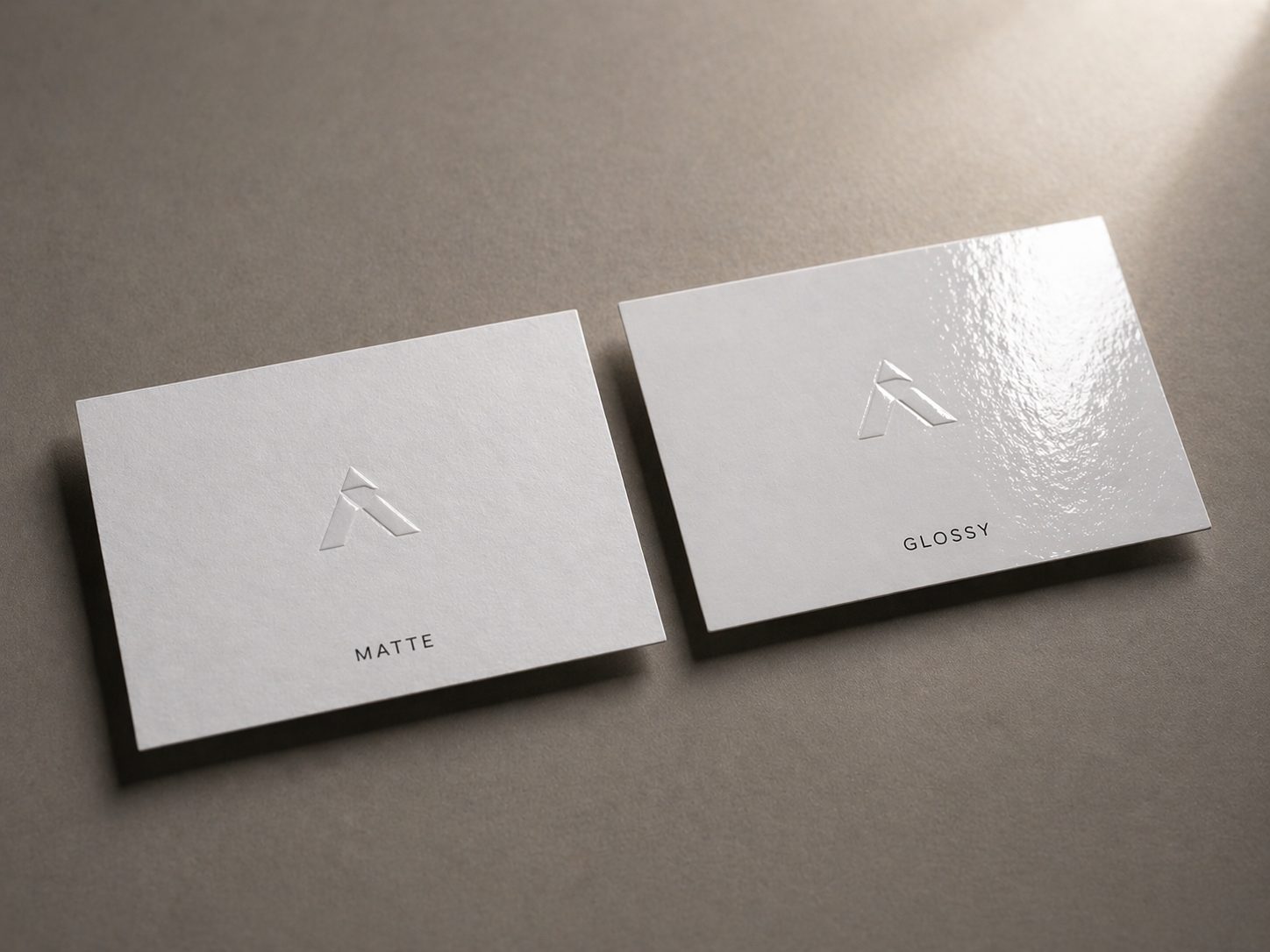
The finish is often the first thing people notice when they handle a card. There are three common options in Singapore:
- Matte lamination — soft, non-reflective, looks more premium, hides fingerprints. Great for minimalist or corporate designs.
- Glossy lamination — shiny, makes photos and vivid colours pop, more fingerprint-prone. Works well for F&B, beauty and creative brands.
- No lamination (matte art card) — natural paper feel, writeable with a ballpoint pen, more eco-looking. Good for therapists, consultants, tradespeople who may write appointment details on the back.
If you’re undecided, matte is the safer long-term choice — it ages better and photographs well when people share your card on social.
Single-sided, double-sided or folded?
A single-sided card shows one face of information. A double-sided card uses the back for a logo, tagline or secondary contact details — there’s almost no price penalty, so double-sided is the default for most businesses.
A folded business card gives you four panels instead of two. This is ideal for:
- Restaurants and cafes — a mini menu inside
- Clinics and salons — appointment card template on one panel
- Tradespeople — service list with pricing tiers
- Agencies — portfolio highlights or client logos
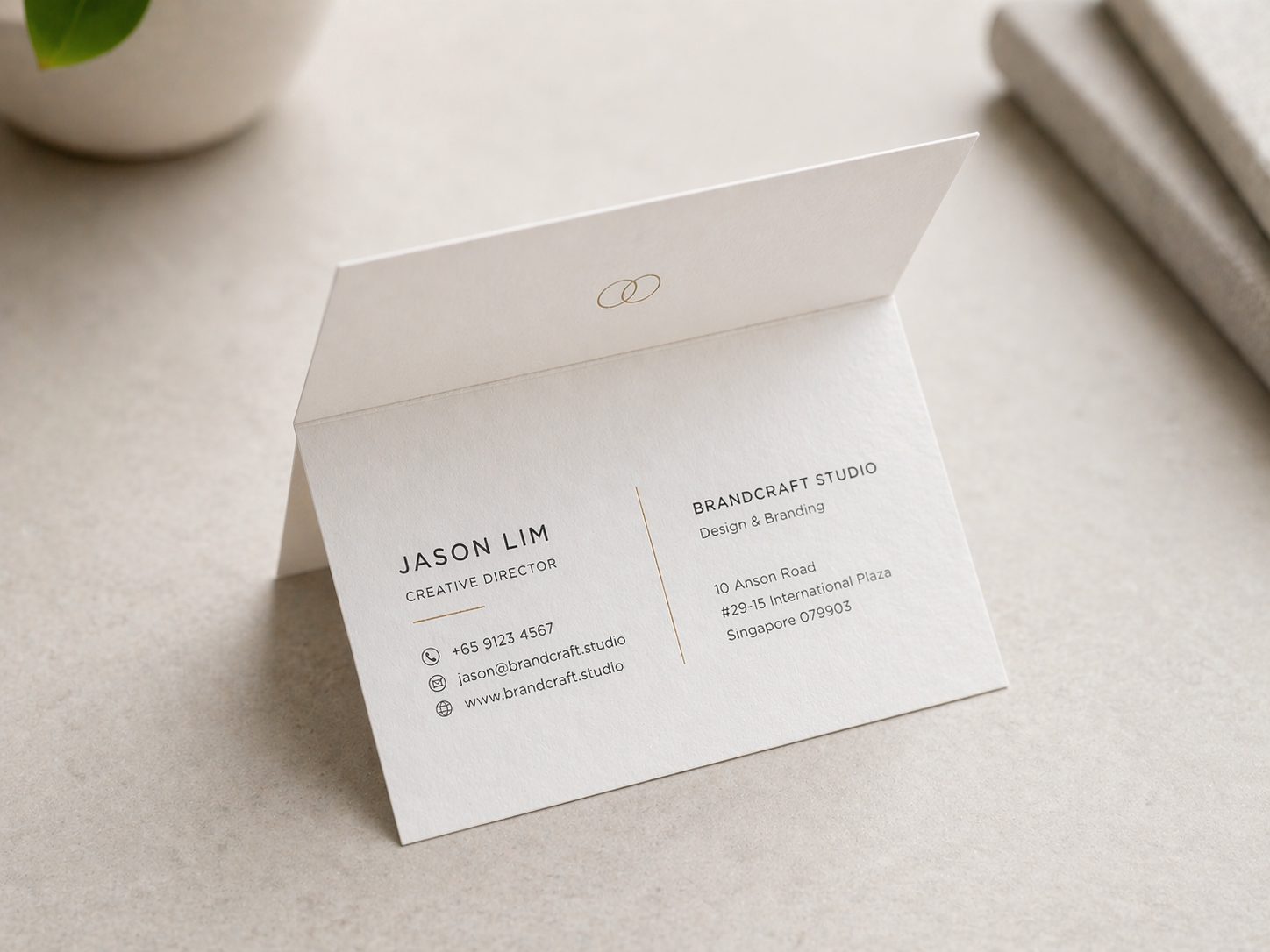
Folded cards cost a little more because of the scoring step, but the extra real estate often replaces a separate flyer — so net-net it’s usually cheaper than printing two pieces.
How many business cards should you print?
A common mistake is printing too few. Below 100 cards, the per-unit cost is high because setup dominates. Above 100 cards, the price per card drops sharply. For most small businesses in Singapore, 300–500 cards per person is the practical minimum — it’s enough for a year of networking without re-ordering, and the tier pricing is far better than 100-piece runs.
If your role, phone or email is likely to change within the next year, print less — 200 is fine. If you’re stable and attend a lot of events, print 500–1,000.
Turnaround times: when can you hold the cards?
At Orange Print, standard offset-printed business cards turn around in 3–5 working days after artwork approval. This is the usual lead time for bulk orders on laminated art card.
If you need them faster, our express digital business card uses digital printing on smaller runs and can be ready in 1 working day for most orders placed before noon. Digital printing has slightly different colour behaviour than offset — large flat colours may look marginally different — but for 90% of designs the difference is invisible to the recipient.
Design and artwork: what to send your printer
When you send artwork to a printer in Singapore, five things need to be right:
- File format — PDF is ideal. Vector files (AI, EPS) are also fine. JPG and PNG work but avoid for anything with small text.
- Resolution — 300 dpi at final size. Any less and edges look soft up close.
- Colour mode — CMYK, not RGB. RGB files print darker and duller than they look on screen.
- Bleed — 3 mm bleed on every edge, with important content (logo, text) at least 3 mm inside the trim line.
- Fonts — outlined (converted to curves) or embedded, so the printer sees exactly what you designed.
If any of this sounds foreign, most printers (including Orange Print) will flag issues before printing. But sending correct artwork from the start shortens turnaround by a day.
Die-cut and custom shapes: small change, big impact
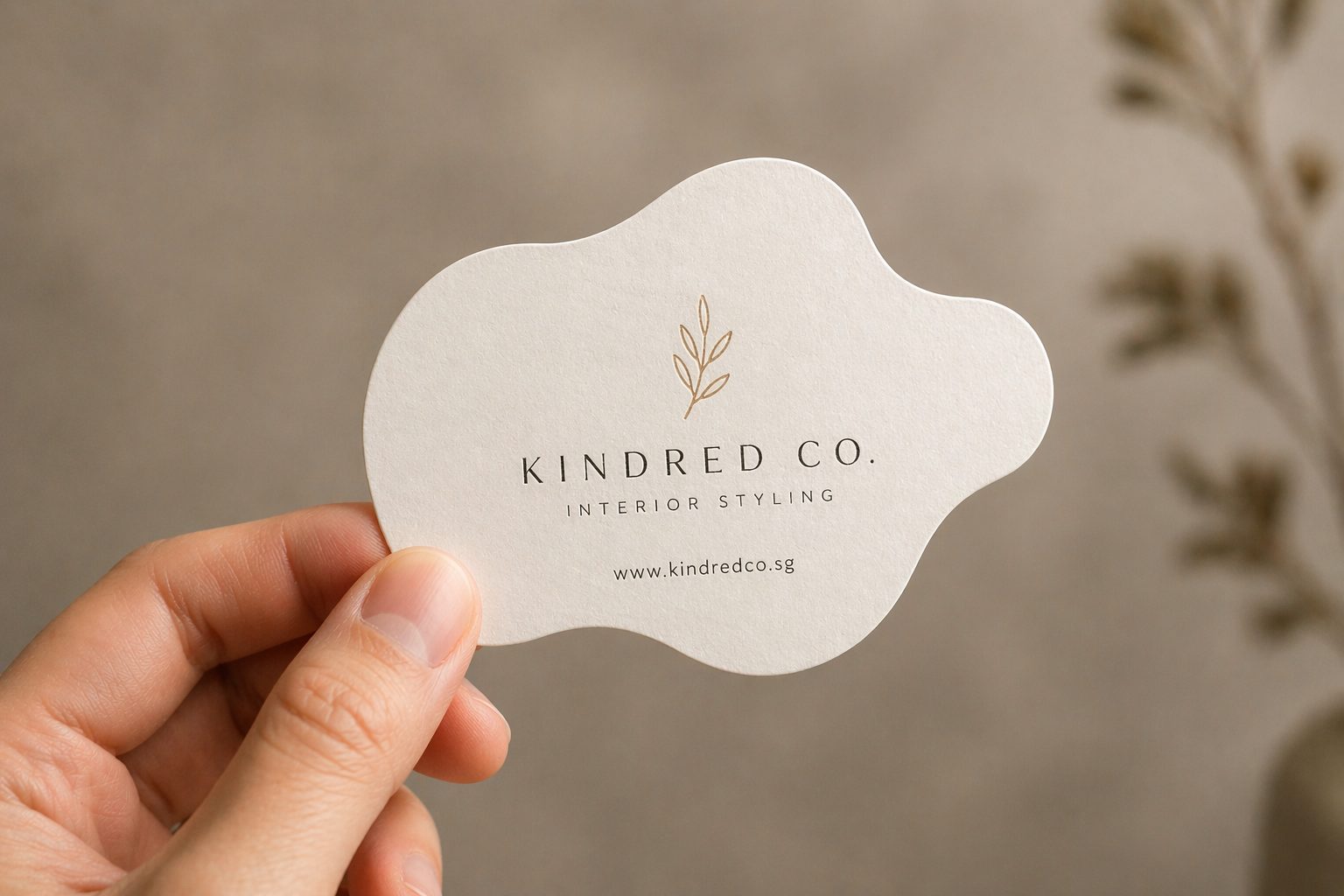
A standard rectangular card is fine. A die-cut business card with rounded corners or a custom shape gets noticed without being weird. Popular die-cut options:
- Rounded corners (soft, premium feel)
- One rounded edge (asymmetric, modern)
- Tag-shaped (hole-punched, works for florists, craft brands)
- Custom silhouette (logo-shaped, for design-heavy brands)
Die-cutting adds a small charge per batch, not per card, so it’s nearly free at 500+ pieces. The perceived value increase is disproportionate to the cost.
Special finishes: foil, spot UV, embossing
Once you’ve nailed the basics, optional finishes can lift a card into “keep forever” territory:
- Hot-stamp foil — metallic gold, silver, rose gold or copper applied to specific areas (logo, name). Very tactile.
- Spot UV — glossy coating over specific areas on a matte card. Creates a subtle shine only visible in certain light.
- Embossing / debossing — raised (embossed) or recessed (debossed) texture, no ink. Feels premium by touch alone.
These finishes add 20–40% to the price and another 2–3 working days. They’re worth it for cards you’ll hand to high-value prospects.
Frequently asked questions
What’s the standard business card size in Singapore?
The standard business card size in Singapore is 90 mm x 54 mm, essentially the same as a credit card. It fits every cardholder and wallet. Other common sizes include square (55 x 55 mm) and mini (85 x 55 mm), but the 90 x 54 mm standard is the safest default.
How much does business card printing cost in Singapore?
Prices depend on quantity, paper, finish and any special effects. As a rough guide at Orange Print, a standard double-sided matte-laminated card starts around S$40 for 100 pieces and drops sharply per unit above 300. Folded, die-cut or foil-finished cards cost more. The best way to get an accurate figure is to check our standard business card page for live pricing.
Matte or glossy business cards — which is more popular?
Matte is more popular in Singapore for corporate, legal, financial and professional services. Glossy is more popular for F&B, beauty, creative and retail. Both print well at Orange Print; the choice is brand-led, not quality-led.
How long does business card printing take?
Standard business cards at Orange Print take 3–5 working days. Our express digital option can deliver in 1 working day if you order before noon. Special finishes like foil or spot UV add 2–3 working days.
Can I print on both sides of a business card?
Yes — double-sided business cards are standard at Orange Print with no price difference on most products. The back is a good place for a logo, tagline, QR code, or a list of services.
Is 300 cards enough for a small business?
300 cards is a practical minimum for a small business owner attending events regularly in Singapore. For a networker or salesperson, 500–1,000 is more realistic. If you expect contact details to change within the year, 200 is fine.
What file format should I send for business card printing?
PDF is the preferred format — ideally 300 dpi, CMYK colour mode, with 3 mm bleed and fonts outlined. Vector files (AI, EPS) are also accepted. Avoid sending Word, PowerPoint or low-resolution JPG files for final artwork.
Ready to print your business cards?
Orange Print offers the full range of business card printing in Singapore — standard, folded, die-cut and express digital — with tiered pricing from 100 pieces upward. Start with our standard business card page for the usual rectangular format, or explore the full business card category for folded, die-cut and express options.